The Wind Down

9/14/17
Our trip is winding down. We will return to Delft, Netherlands and stay for several days. We want to mail home a box of incidentals that, if we bring on the plane, will put us over our baggage limit. Delft ought to be the best place to accomplish that.
The weather has turned towards fall with cooler, wetter weather. Kinda like when we arrived.
We spent 6 days in Delft, wandering the town, enjoying fresh herring and kibblings (deep fried cod) for lunches and accomplishing our task to mail home a box of “stuff.” Next on our itinerary is Utrecht where we will pick up our luggage bags then Edam (more cheese!), Voledam (more herring!), Amsterdam (more everything!) and finally, after we return the Hymer to Utrecht, our last night will be spent in a hotel near the airport before our flight home.
Thirteen nights remain before departure and we have a lot of bittersweet thoughts as we wrap things up. A part of us is very ready to come home but another part already misses the Europe we didn’t see this time. We planned to visit the Mediterranean countries in the second half of a projected year-long trip. Our decision to return home has forfeited those countries. Croatia and Portugal would have been new territory for us, while southern France, Italy and Spain are well loved and will be missed. These are good reasons for a return visit someday.

Here are some travel statistics for you:
• Five months, 1 week on the road.
• 62 campgrounds in eight countries.
• 4719 miles/7595km
• 20 fuel fill-ups.
• 223 gallons/847 liters diesel totaling $1,106.00US
• Average mpg/km/l – 22.7/9.6
• Average price per gallon: $4.95US
We lost count of the number of croissants and pain au chocolate consumed (although our waistlines didn’t).
Pepsi, Riesling wines and sparkling waters were the beverages of choice (guess who preferred which).
Brie cheese, sliced ham and tomatoes, mayo and mustard on French baguettes was a favorite lunch.
We cooked nearly all our dinners and ate quite well.
Lidl, once our favorite grocery store, was replaced by any of the great supermarket chains: Carrefour and Auchan in France, Sainsbury and Tesco in the UK, Albert Hein and Nettorama discount in Netherlands, Dehaize in Belgium & Luxembourg. Surprisingly, we came across few farmers markets, although they are still a weekly institution in the towns and cities we visited, we just hit the wrong days.
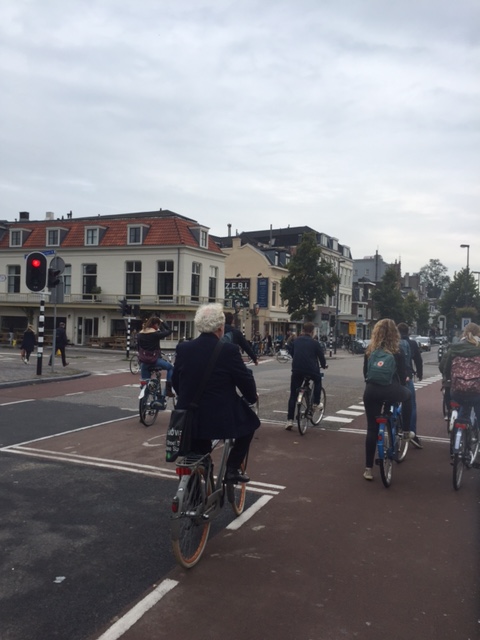
Our bicycles were a good investment, although we were terrified to ride them in the UK with its small roads and no bike lanes. But Holland… in Holland bikes are king. They have their own lanes, their own traffic lights and cars and pedestrians must yield to their presence. The confidence these Dutch riders have is astounding and we wish we had half of it. They are like herd animals, riding the streets by the hundreds. If urban United States respected bicyclists half as much as the Netherlands do, much of our traffic congestion would be greatly lessened and we would be healthier for it.

9/22/17 – Utrecht
We returned to our very first ever campground. Once known as Camping Buerenkil, it closed down sometime after our first trip but has reopened as Budget Camping Utrecht. It is in the middle of a massive renovation project and is hardly recognizable. The old shower block and restaurant are gone, soon to be replaced. A temporary shower block is in place and while smaller, is in much better shape than the old one. There are plans for 80 cabin rentals. Budget camping Utrecht’s advantage is proximity to town center – about a 10 minute bike ride.

We stayed for two nights and rode our bikes into Utrecht each day. On the second day we went to Donna’ place to collect our rolling duffle bags. We have see Dutch bike riders carrying 6-ft ladders, 2×4 wooden studs and furniture dollies. We strapped our duffle bags to the back of the bike racks and returned to the camping feeling like we belonged!
IMG_5212
Biking downtown Utrecht
IMG_5206
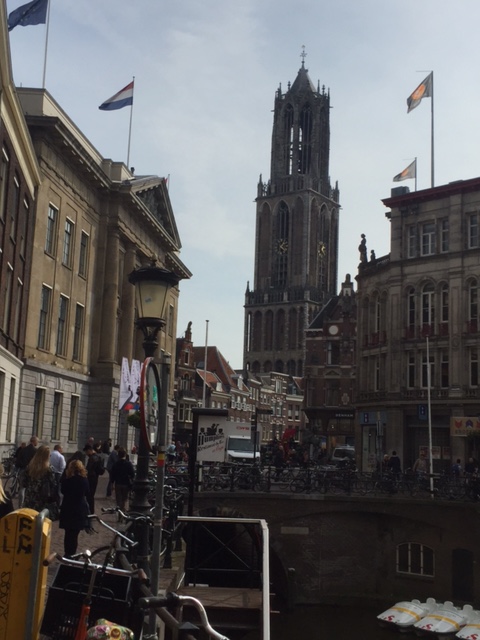
The Dom – downtown Utrecht
IMG_5209
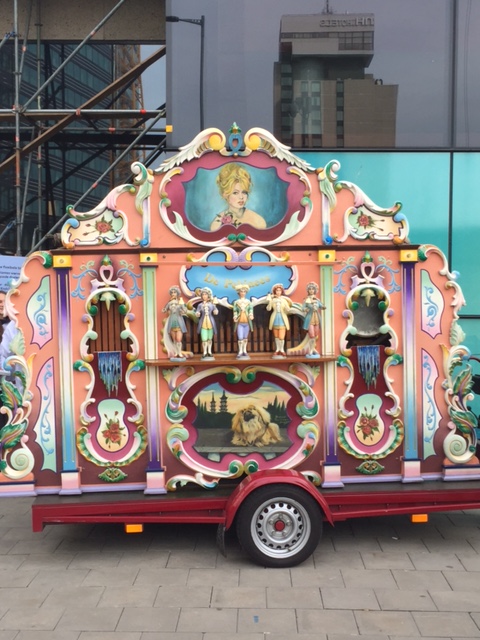
Street Organ
IMG_5207
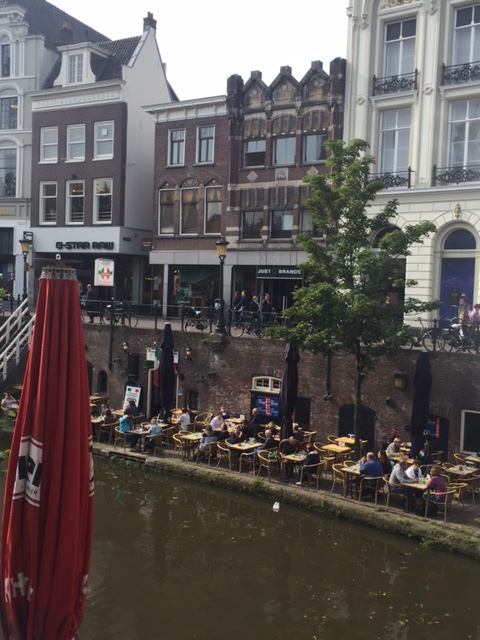
Utrecht canal

IMG_5205

As we took our bikes from the camping to Donna’s house we rode through the university district and found a whole area of Utrecht we hadn’t discovered on our previous visits. All in all, we found in Utrecht a city that would be a pleasure to live in; not too big and with all the culture and excitement of university towns.
IMG_4335

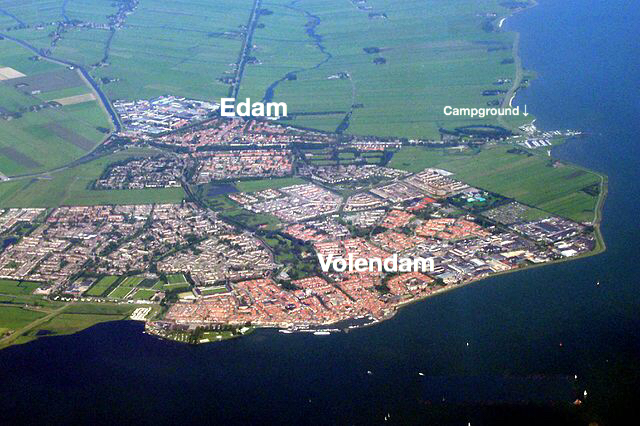
We still had about 10 days left so we spent three of them in a return visit to Edam/Volendam. Fourteen miles north of Amsterdam, it rests on the Markermeer, the southern portion of the former Zuiderzee, Holland’s great shallow bay of the North Sea. In the early 20th century, after a ruinous flood, a long dike was erected, closing off the Zuiderzee from the North Sea and creating 2 lakes; the IJsselmeer and Markermeer.

We were able to easily ride our bicycles between Edam and Volendam as well as use them to explore the two towns.
Volendam Harbor is a popular tourist attraction. That means the harbor front is loaded with kitschy souvenir shops and hundreds and hundreds of visitors from all over the world clogging the quay. It’s funny that one street off the harbor front, the town is as quiet and peaceful and charming as can be. Few tourists venture off the quay, I’m sure much to the relief of the locals. It appeared that in this little town the locals could have their cake and eat it too: rake in the tourist monies and yet, one street away, retain their lifestyle and their sanity.
IMG_4277

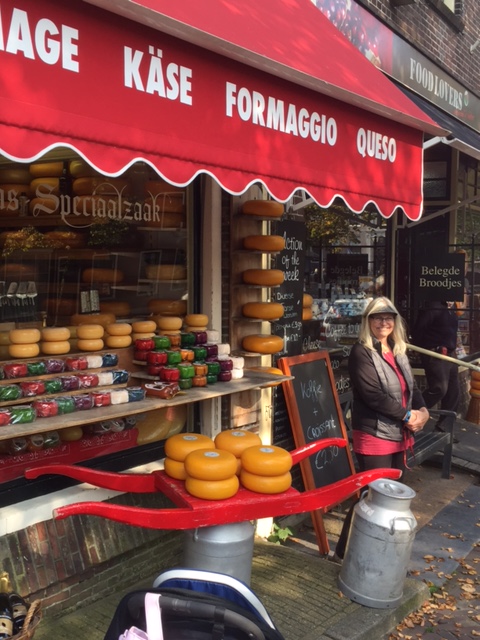
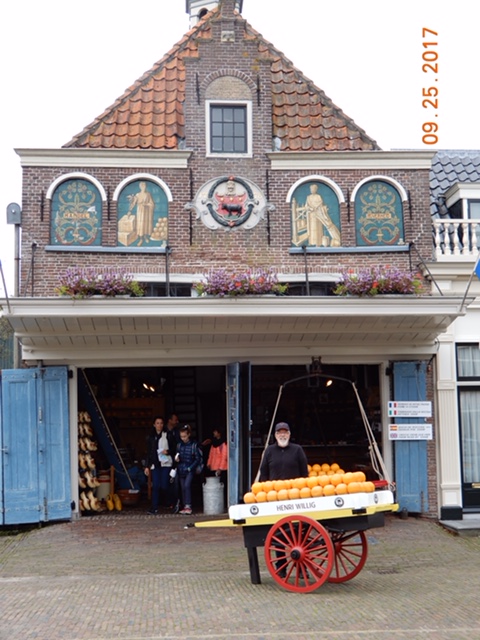
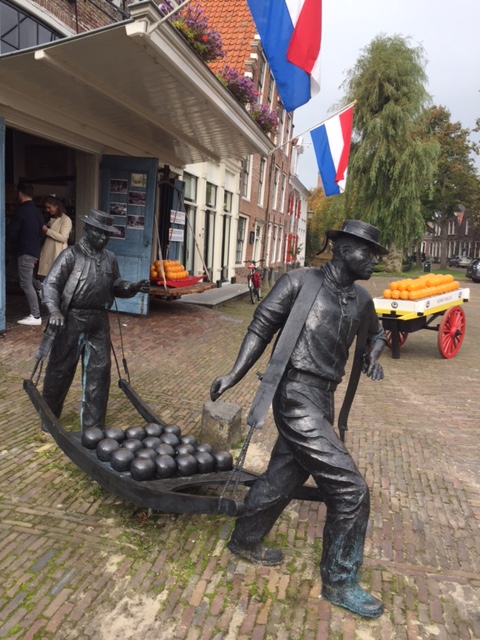
Edam, slightly inland from the sea, is where Edam cheese originates and the town has several tempting cheese shops. In the 1500s Edam was granted the right to have a weekly market that developed into a cheese market. Farmers brought in their cheeses into town by boat where the cheeses were tested for quality and selling prices haggled over. Then the cheese rounds were stored in a great warehouse until they had aged to perfection.

The old city center is protected by the government for its main structures and architectural details. Several historical buildings remain: St. Nicolas church, a massive brick structure built on pilings to counter sinking from the weight of the building materials; the Town Hall, still actively used for marriage ceremonies; the Edam Museum, oldest brick house in the town (1530); the Carillon, the bell tower of a church demolished in 1800s. The bells, made in 1566, are outside the lantern and still ring out a short melody every 15 minutes.
DSCN4044IMG_4324

We found the Cheese Market. We learned that 85% of Edam cheese is sold to tourists and exported to other countries, that the Dutch much prefer Gouda cheese over Edam because Gouda can be flavored with herbs and spices.

Edam was full of charming streets, canals and houses.

Our camping was right on the Markermeer:

Next stop: Amsterdam
All for the love of Carrefour

9/11/17 – Laon, France

IMG_4161

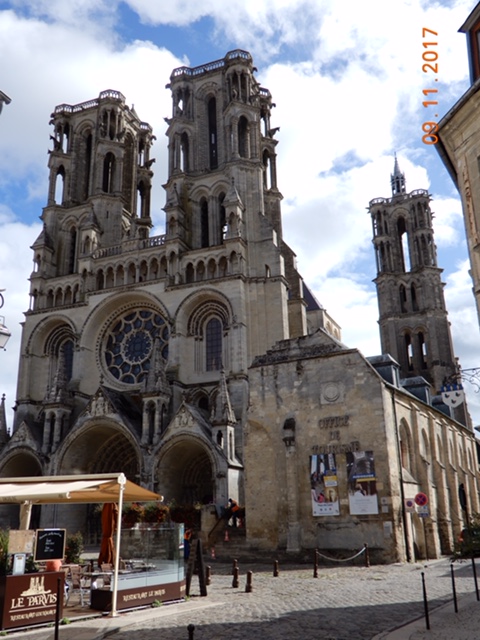
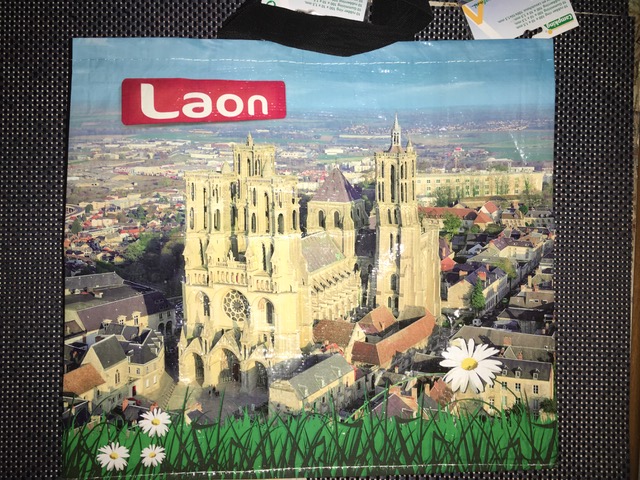
Based on the photo on a Carrefour shopping bag, we decided to visit the French town of Laon, about 85 miles NE of Paris. It was our last stop in France as we headed to the Netherlands in preparation for our return home. Laon has an early Gothic cathedral, and evidently we haven’t had our fill of cathedrals yet.
The land north of Paris, the Picardy region, was made up of flat plains and gentle rolling hills used as farmland. On our way we passed the small city of Soisson whose name is of Celtic origin and was conquered by Julius Caesar. It had a great looking dual-spired church that caught our eye (but not our camera).
Laon sits atop a high steep hump of limestone some 330 feet above the surrounding plains. Because of that height, it has been a strategic location since long before Roman times. After Christianity arrived in the 4th century the town gained prominence when an archbishop from Laon baptised Clovis I as the first Christian Frankish king.
The city and surrounding area played a part in the history of the Merovingian, Carolingian, Capetian and Bourbon royal dynasties (kings & queens from all those dynasties are buried in St. Denis). A courtyard called the Dauphine Courtyard once belonged to an inn where King Louis XIII and his queen stayed and where it is suspected that the Sun King – Louis XIV was conceived. Below the city, in a forest not too far off, legend says that Pepin le Bref and his wife Bertrada au Grand Pied conceived Charlemagne. (My translation of the French names is: Pepin the Short and his wife Berthe Big Foot. What a pair!)
I find this rich history amazing since I never heard of the place, except for a photo on a supermarket bag.
We camped at the base of the hill in an oak woods and took a bus up to the city.
The medieval town is still intact with walls encircling it.

IMG_4100

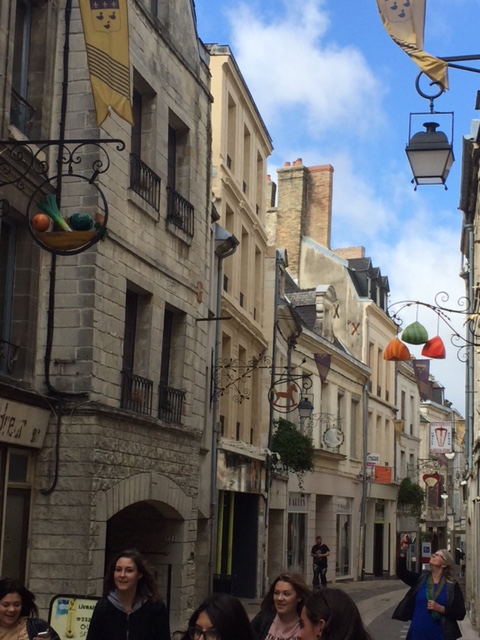
We came for the cathedral but enjoyed walking down the narrow streets and seeing the decorative signs hanging from the storefronts, describing the business within. The last time we saw so many different signs was at Colmar in the Alsace-Lorraine.

DSCN3961
West Facade of Laon cathedral
CA93B3BD-91AA-4BBC-A469-F86656EDF441
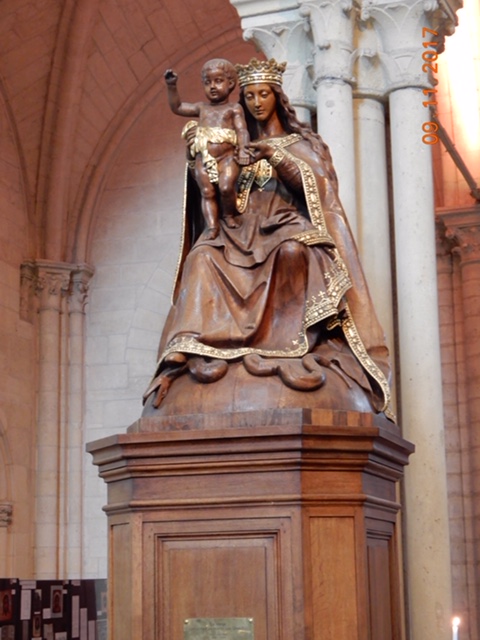
Statue honoring Mary
1D2AE214-AF1A-4624-A23A-0B018612B97D
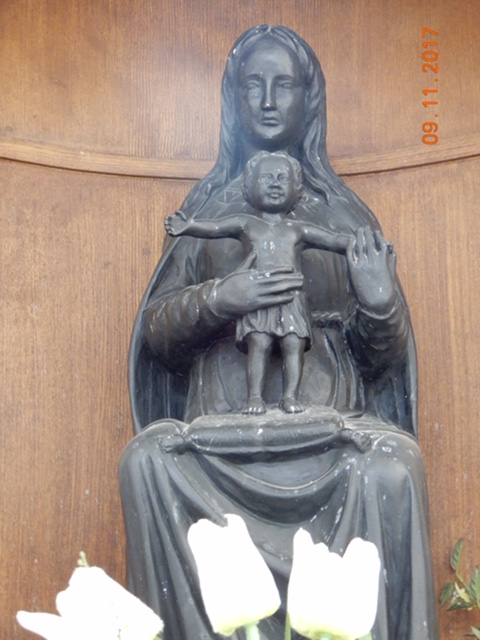
Another Mary statue
5A22C373-EC0E-4BF9-BA45-8C1319020E27
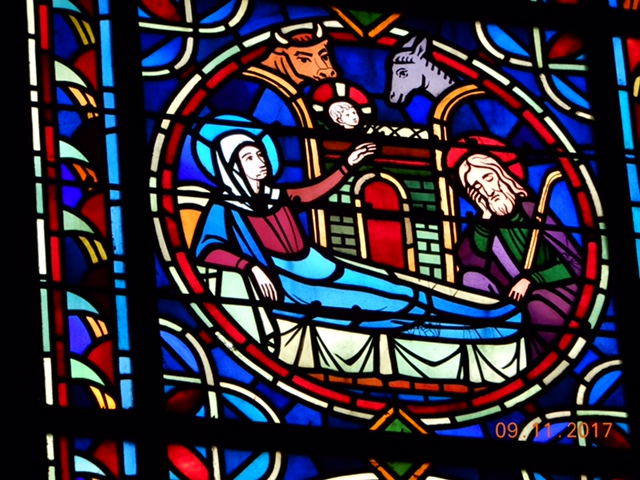
And a stained glass closeup of Mary (navitiy)

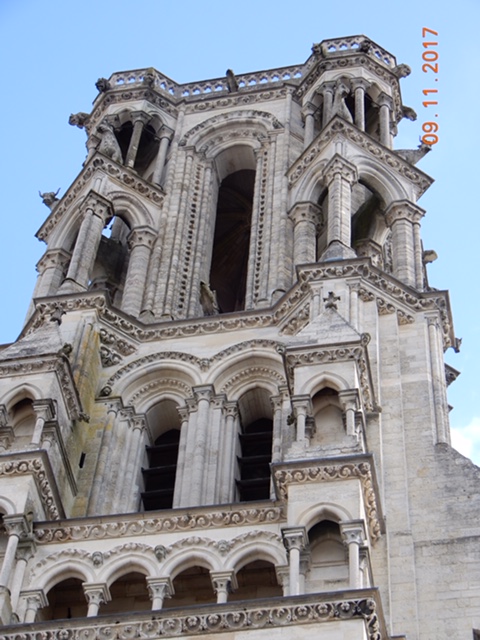
The cathedral – another one dedicated to Mary – was completed in 1235AD. It has five towers (usually we only see two).

5C38504F-EFD0-4007-B791-88ABEC7EFC25F9097CC3-E929-4F2D-8F7E-3CE05DD802FF

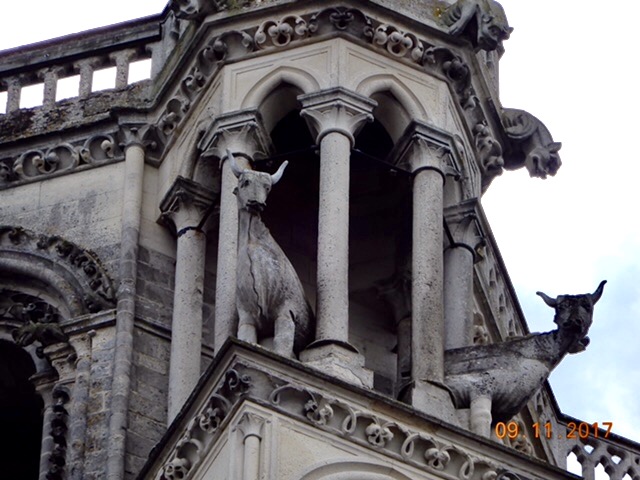
The two on the western front have sixteen stone oxen looking down on square below with gargoyles above them. These oxen are said to be some of the finest examples of 12th century animal sculpture.

DSCN3973
East rose window
214E0D8F-8164-4ADE-92AE-5D7D2E162056
Science rose window


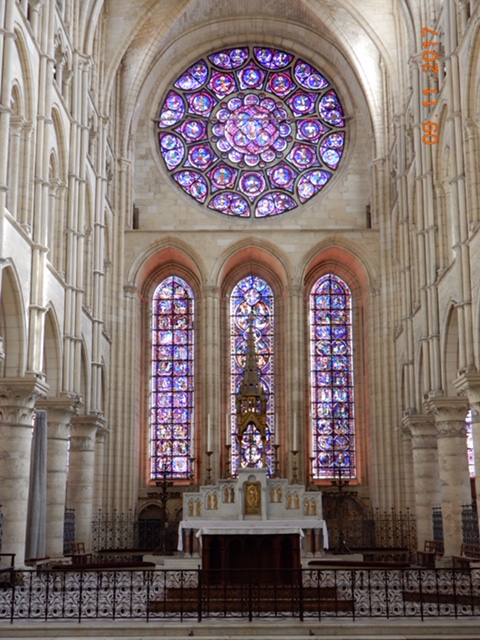
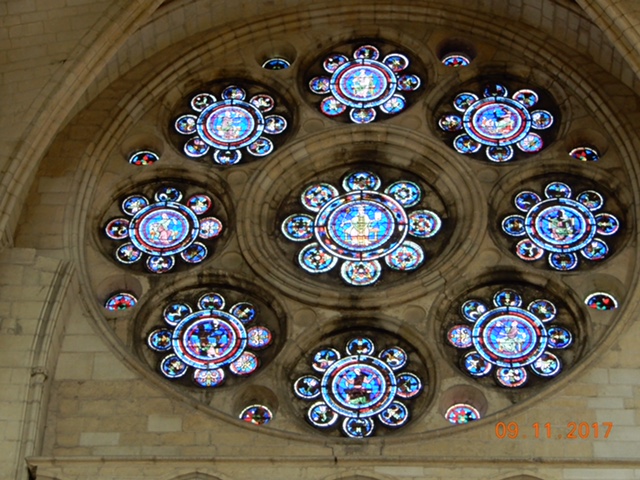
The cathedral has four rose windows.The lovely rose window on the eastern façade behind the main alter is dedicated to Mary. Beneath it are three lancet windows, each telling the stories of Mary, Jesus and Saints Stephen and Theophile. Another rose window represents the sciences as understood in the 13th century: Philosophy, Arithmetic, Rhetoric, Grammer, Dialectic, Astronomy, Medicine, Geometry and Music. This is the first rose window I have seen that isn’t dedicated to a religious theme.

DSCN3964

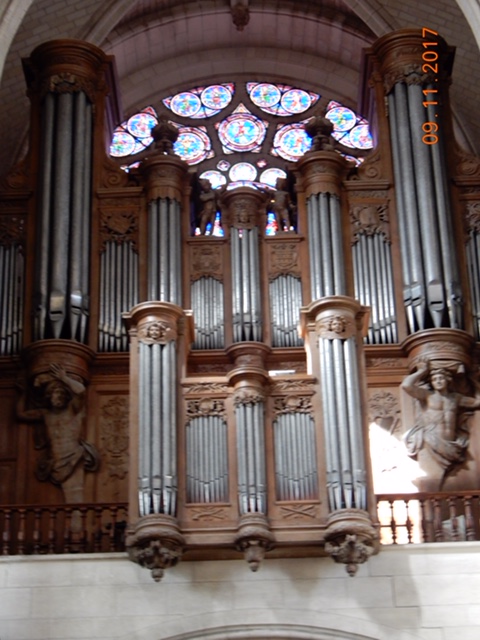
The western rose window is hidden behind a great organ installed at a much later date. The organ is interesting because it has large carved human figures holding up organ pipes. We’ve only seen one other organ with similar carvings, so they are not common.

763F70B7-0328-41F3-BD9C-45193081C35059C103D8-4570-494B-A3B5-9F34895A7063

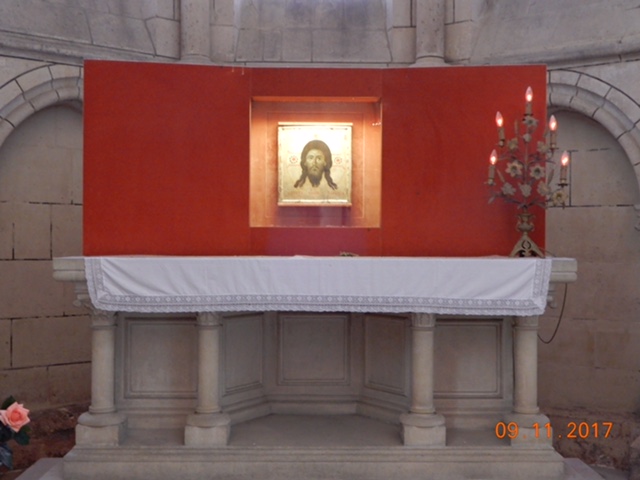
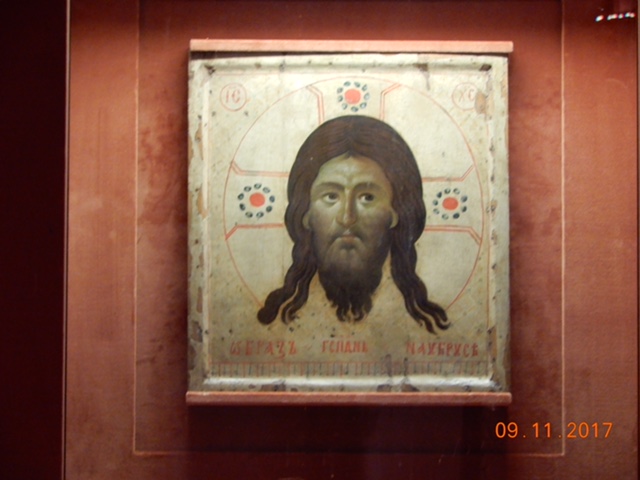
There are a lot of chapels off the sides of the lengthy nave. In one of the chapels is an iconographic painting of Jesus, purchased in Italy in 1249AD by the archdiocese of Laon. Besides the cathedral there were 3-4 other churches in the city that were active during the same timespan as the cathedral, all in the relatively small area that made up the city. Seems to me like a lot of religious competition.

We finished our walkabout with lunch at one of three kebab restaurants in town and returned to our bus stop and the campsite.

Quite like Fougeres, this city is still undiscovered. No tourist buses and no hordes to contend with. It was a great stop, and all because of a shopping bag.

We love Paris – all the time

9/7/17 Paris, part 2:
Our Hemingway tour expanded into a mini-literary tour when we went in search of the original location of Sylvia Beach’s bookstore “Shakespeare and Company” on Rue de l’Odeon in the 6th arrondissement.

E9161B3F-0559-4354-959E-BF8CC156A50D
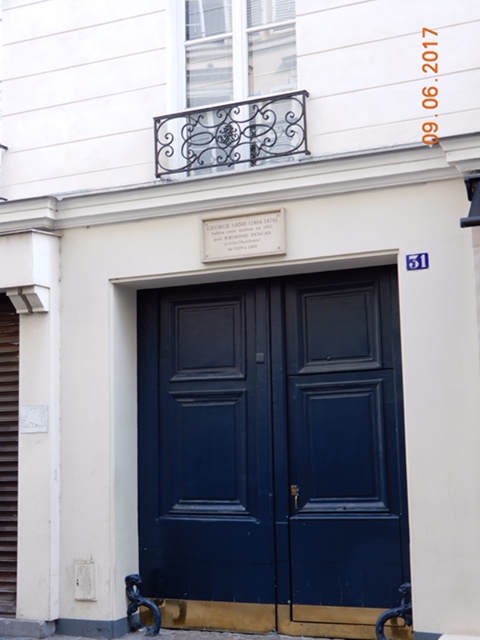
Rue de Seine where George Sand lived

On our way we found a plaque on Rue de Seine detailing how French author Amantine Lucile Aurora Dupin – more commonly know by her pseudonym, George Sand – had lived at that house for a year in 1831.

We also stumbled across the home of French painter Eugene Delacroix, located off the charming, tiny Furstenberg Square.

DSCN3725

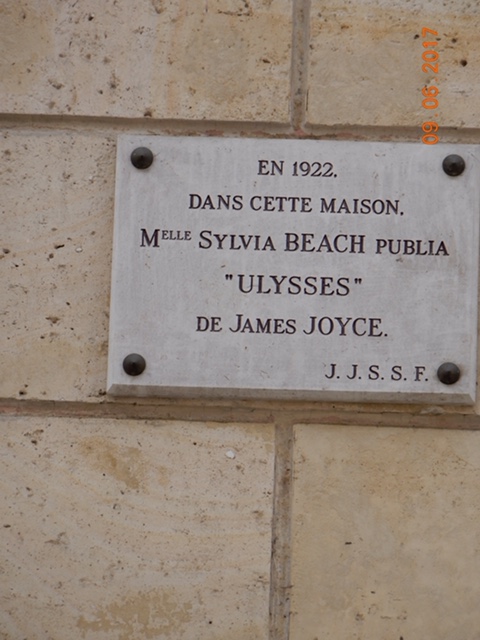
Once we reached Rue de l’Odeon, we learned that not only did Sylvia Beach have her bookstore there, but that she published James Joyce’s novel “Ulysses” from that location.

6582DD6E-797C-4021-AE6D-FF07469E6208

DSCN3728
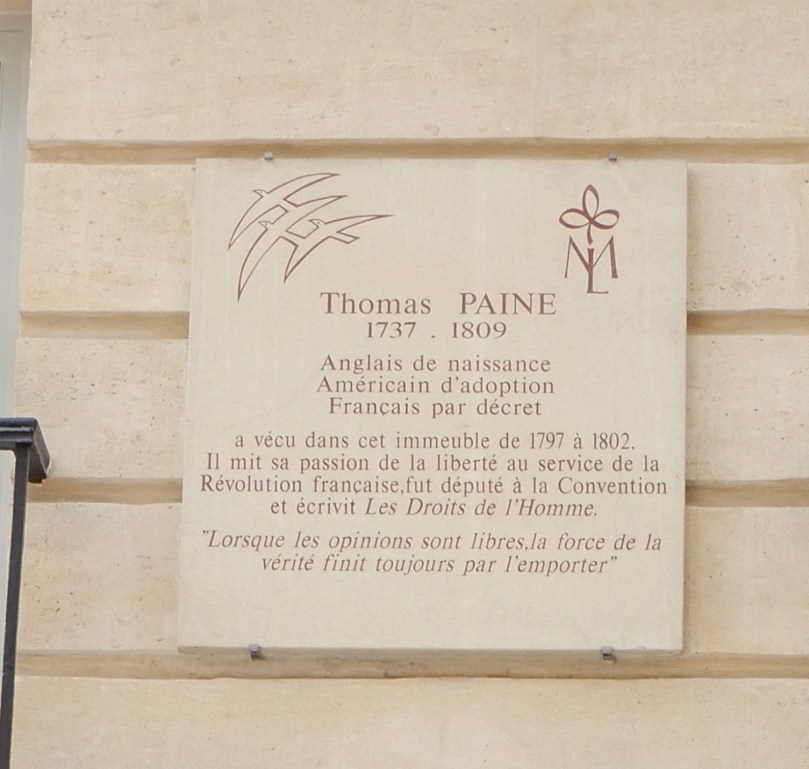
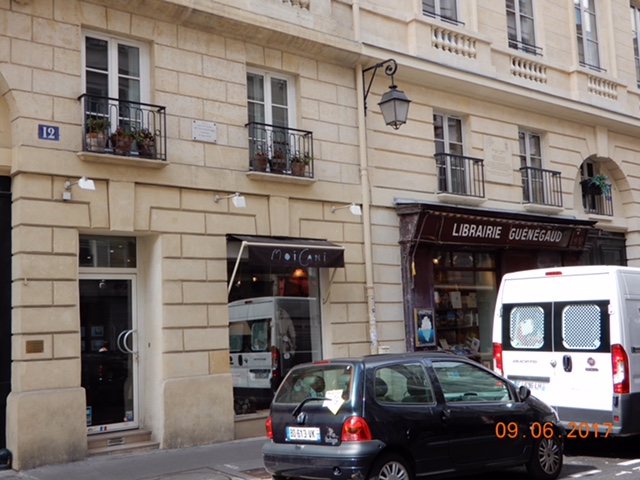
Original “Shakespeare & Co. bookstore and Thomas Paine flat

Two doors down, and in an earlier time, one of our own Founding Fathers, Thomas Paine – author of the influential “Common Sense” lived. He wrote “Rights of Man” while living on Rue de l’Odeon. It’s a pretty impressive street.

DSCN3710

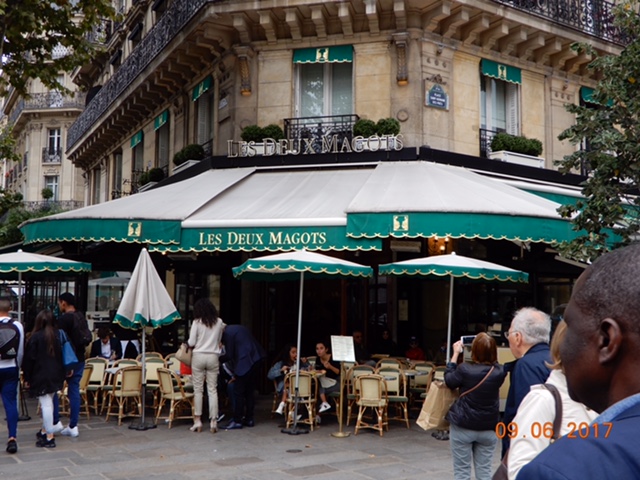
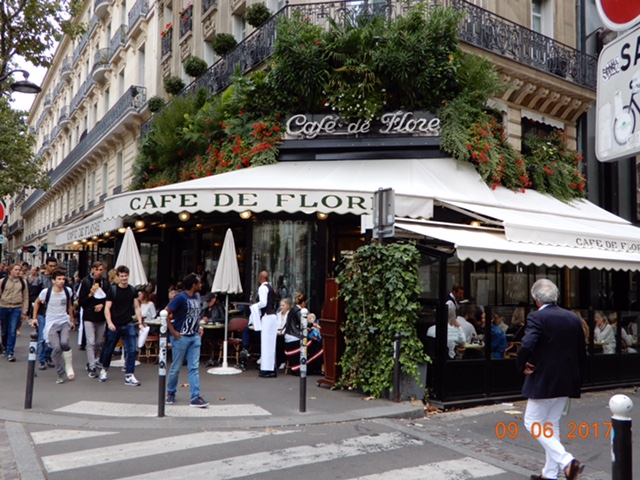
Our next quest was for the cafes Hemingway and fellow literati frequented. We walked Blvd Saint-Germain – a delightfully busy street – until we came upon Les Deux Magots, supposedly Hemingway’s favorite spot in Paris in the 1920s. It turns out other famous authors and artists favored the café as well: Jean Paul Sartre, Simon de Beauvoir, even Picasso stopped by.

DSCN3712

Les Deux Magots’ chief rival was the Café Flore, a short block away. Both cafes were used as “offices” for impoverished writers in the 1920s. Buy a coffee and they could occupy a table for hours on end, writing and holding court. Today they are a tourist destination and probably a lot more expensive.

DSCN3719DSCN3721

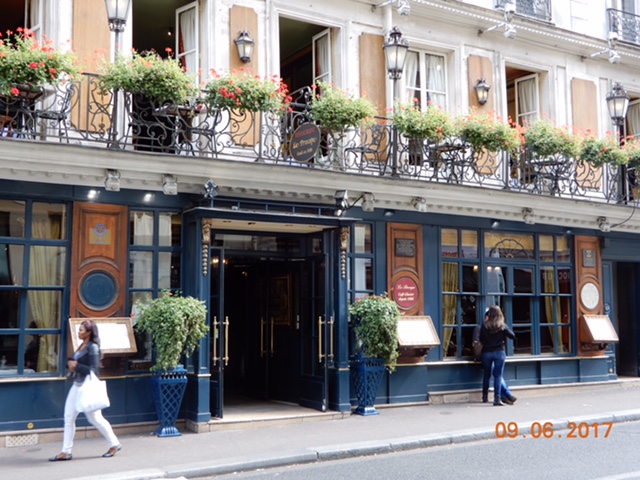
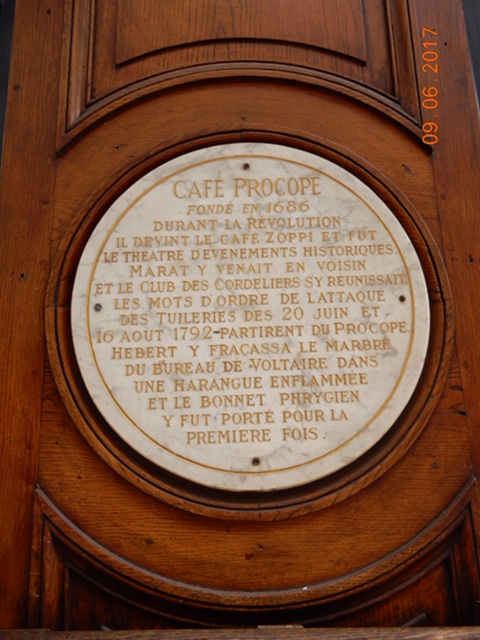
Other cafes we saw were Brassiere Lipp, also frequented by Hemingway, and a little off literary topic, the Cafe Procope, oldest café in Paris, founded in 1686.

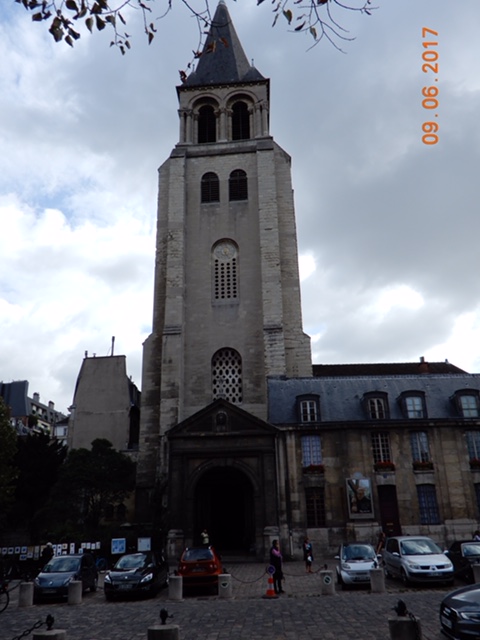
We visited Eglise Saint-Germain du Pres, from whom the district (and boulevard) gets its name.

C1F6B415-34B2-4910-A09D-BAB7F275E62C

This is the oldest church in Paris, originating in 542AD. It has had many changes over the centuries and currently is undergoing a seriously needed cleaning of the interior. What has been completed shows a vibrant use of color on ceilings, walls and columns vs the gray, darkened pre-cleaned appearance. Bruce says he almost likes the pre-cleaned look better because the colors are so vivid and he wonders why they picked the color combos they did. I think it looks great.

FD99EEE1-7228-4323-9500-F2B3476AEB57

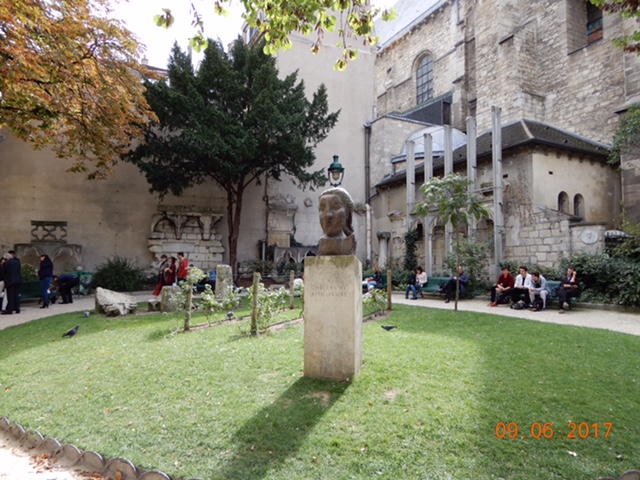
Behind the church is a small, peaceful square with an original sculpture by Picasso, “Homage to Apollinaire,” a tribute to a poet friend.
We found a website – smarterparis.com – that suggested a walking route through some of the covered walkways near the Grand Boulevards. We weren’t aware of these walkways so we decided to explore them. During the first half of the 19th century these covered arcades became very popular. Located mainly on the right bank, they contained shops and cafes catering to the wealthy.

The walk suggested we begin at the Palais Royal. Conveniently, it was new territory for us in keeping with our desire to see new things this trip. The Palace – a gargantuan affair – was built by Cardinal Richelieu (of infamous Three Musketeers fame) in 1639 and called Palais Cardinal. The royal family took over ownership after the Cardinal’s death and renamed it.

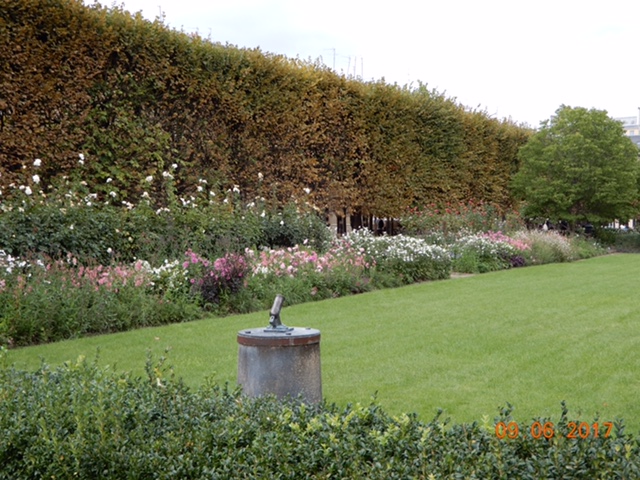
In 1830 the large inner courtyard – the Cour d’Honneur – was enclosed creating Paris’s most famous covered arcade – the Galerie d’Orleans. Unfortunately for our tour, it was demolished in the 1930s although the pairs of columns still stand. The garden area of the Palais was nicely laid out with sculptures, trees providing shade and two floral gardens separated by a great circular fountain spraying green algae-filled water all around (that was the one negative in the garden).

1112DD03-2E09-4A1B-B81C-2E5BD7FFE167

A teeny tiny cannon is mounted on a small plinth in the center of the garden. It has been there since 1786. It used to fire every (sunny) day at noon, with its fuse lit by the sun’s noon rays magnified through a lens. Too bad that doesn’t happen anymore.

Leaving the Palais-Royal we walked through the entrance of the Galerie Vivienne and were flabbergasted. Clothing boutiques, wine cellars, bookstores, gourmet food shops and tea rooms flanked a wide mosaic tiled floor with a beautiful glass roof. The galerie was quite long and quite lovely. Built in 1823 it still had a very old world feel to it.

DSCN3776DSCN3778

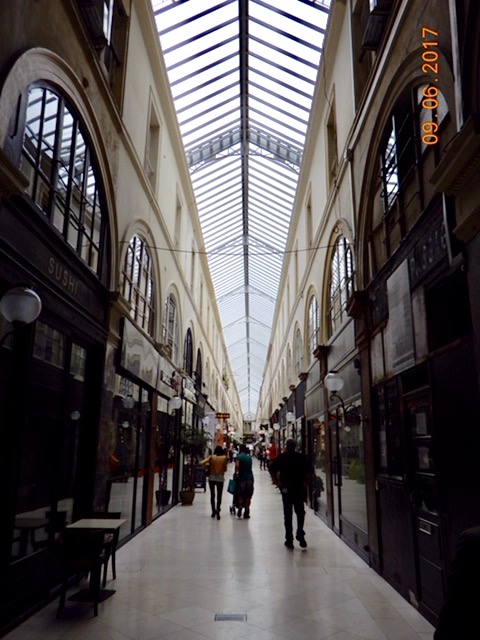
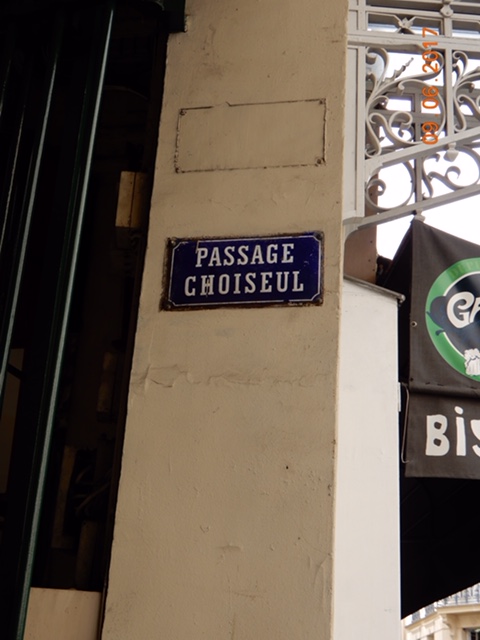
From the Galerie Vivienne, we next found the Passage Choiseul. Another oldie – built in 1825 – it was not as elegant but still grand and quite well used.
From the Passage Choiseul, we got off track from the “tour” and spent the rest of our day following streets that looked interesting.

We had one more day in Paris and we chose to visit the Basilica of St. Denis, in the northern suburb of Paris. St. Denis was originally a Gallo-Roman cemetery. They are still finding remains there in archeological digs.

74F73B40-4331-419A-B47B-098CA511058B
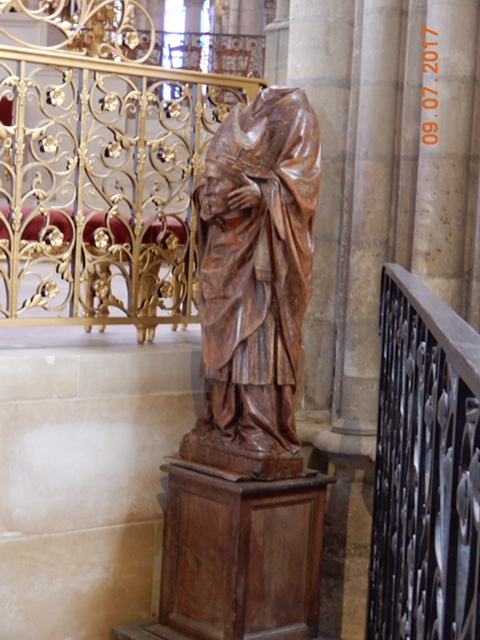
St. Denis holding his head

St. Denis is a Christian martyr of the 3rd century who was beheaded by the Romans for his faith. He is the patron saint of Paris and France. Christian legend has it that he picked up his decapitated head and walked for several miles to St. Denis, preaching repentance.
St. Genevieve, who is also the patron saint of Paris (they can have several patron saints? Doesn’t that diminish the importance?) purchased land in 475 AD and built St. Denys de la Chapelle. Dagobert, king of the Franks, had St. Denis’ relics reinterred at the basilica in 639AD. Dagobert was the first king to be buried in the basilica.

The basilica became a place of pilgrimage and the burial place of French Kings with nearly every king from the 10th to the 18th centuries being buried there, as well as many from previous centuries. The earliest French King to be re-interred was Clovis, the first king of the Franks and the founder of the Merovingian dynasty. He was also the first French king to become a Christian, circa 496AD. (If you read Dan Brown’s fictional book “The Da Vinci Code” you may remember the Merovingians were supposedly descendants of Mary Magdalene.)
The Basilica of St. Denis – originally an abbey – is regarded the first Gothic church from which all other Gothic churches were patterned. It had two great spires on its western façade, but in 1846, a violent storm damaged them so severely, one had to be torn down and the other abbreviated in height.

Today there is a renovation project to enhance the interior and also rebuilt the missing spire (there was a lot of noise going on in the church what with the workers and their power tools).

DSCN3783
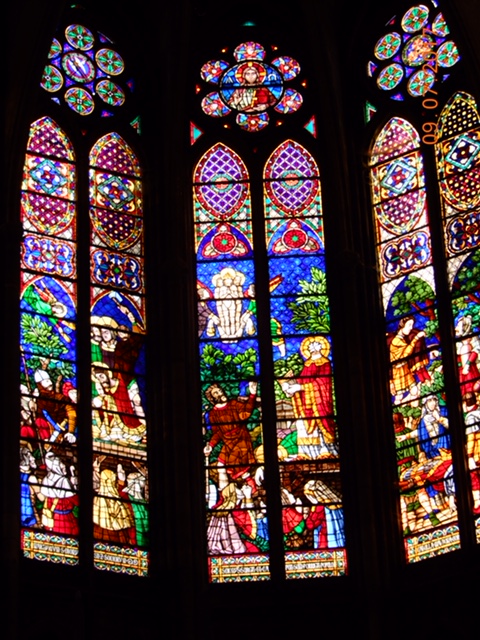
Stained glass windows
CEEA2D10-728A-4483-851B-33D07AD3C2AF
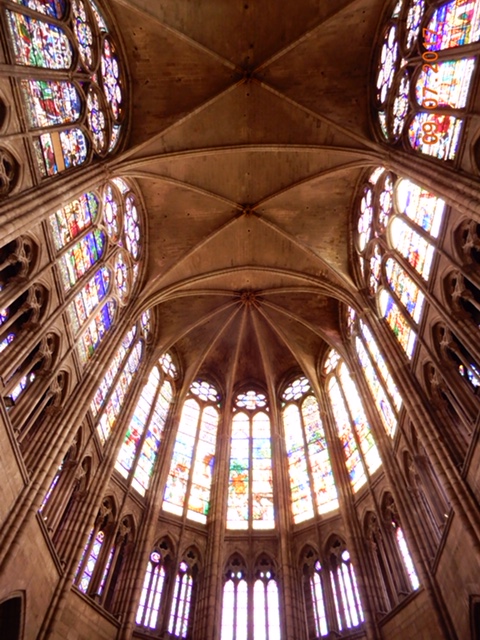
St. Denis choir ceiling
DSCN3786
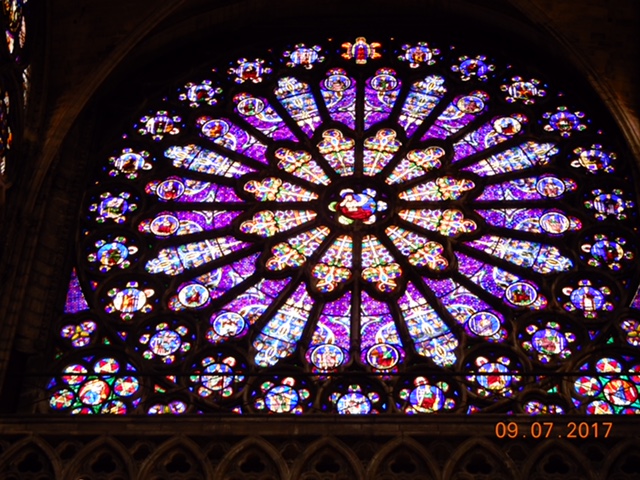
St. Denis west rose window
DSCN3788
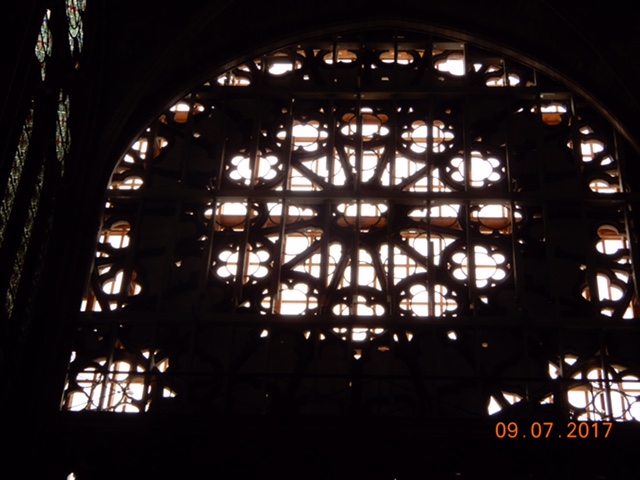
East rose window without stained glass, in middle of restoration

The interior has stained glass windows representing all the kings of France, and effigies and tombs abound representing those kings and their queens.


We saw the tomb of Francois I, the French king responsible for bring Leonardo da Vinci (and the Mona Lisa) to France. We saw the tomb of Clovis I, we saw effigies of Charles Martel and Pepin the Short – grandfather and father of Charlemagne.

93F0A710-DA88-4E7A-842F-EA254B86D54A

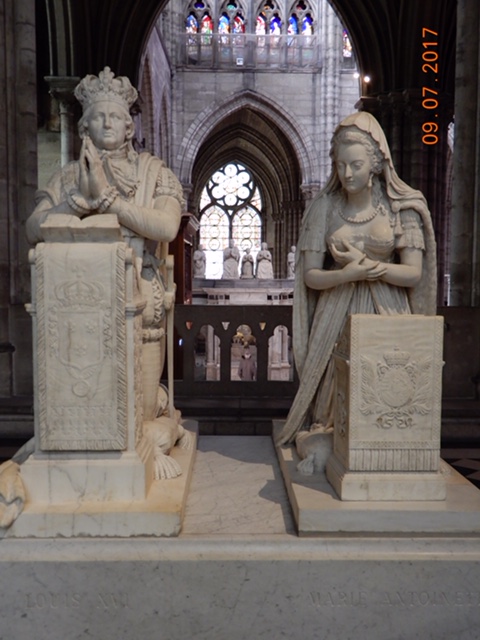
Below in the crypt, we found the remains of Louis XVI and his wife Marie Antoinette, in the Bourbon vault. Above, in the church itself was a memorial statue of them. We saw the tomb of Louis XIV – the Sun King and longest reigning monarch at 72+years.

31A8BF8A-2367-4312-8F27-D992485282E9
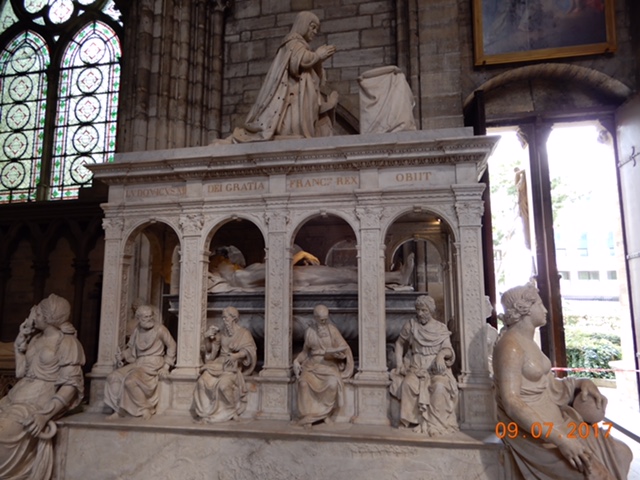
Henry II & Catherine d’Medici
0260D09C-7AC0-493D-99DD-65B7F9B94121
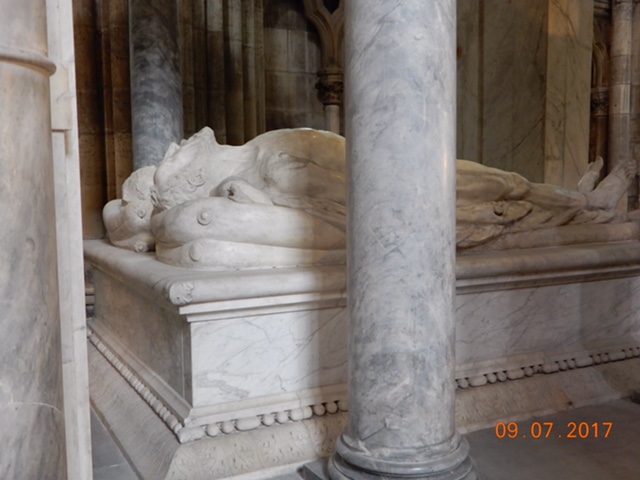
Closeup of tomb

We saw Henry II and his wife, Catherine d’Medici, who was responsible for the creation of the Tuileries Gardens.

There are a lot of dead kings and queens at Basilica St. Denis.

We returned to Paris proper and began a round robin of many of the sights that are iconic Paris: Arche de Triomph, Place de Concorde, Champs Elysee, Eiffel Tower, Tuileries Gardens, Louvres, Ile St.Louis, Notre Dame and our favorite street in Paris: Rue de Rivoli.

DSCN3920

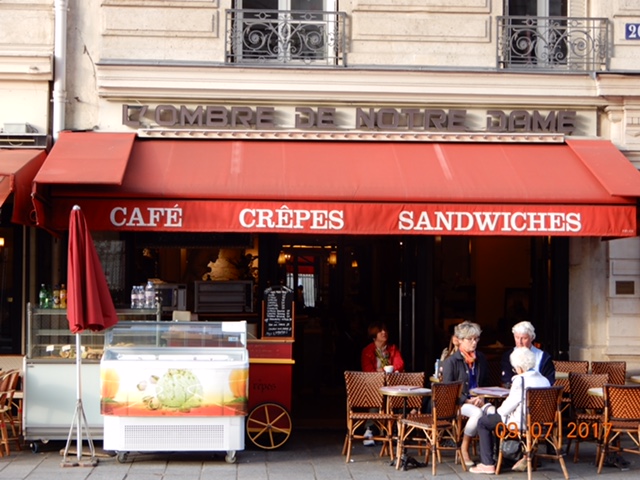
We finished off our day with French Onion Soup at our traditional restaurant in the shadow of Notre Dame. The very same waiter we had on our first visit in 1999 is still there!
We love Paris.

We’ll always have Paris

9/4/17 – Paris – part 1:

We have been fortunate enough to have visited Paris four times previous to this visit. I could not begin to improve on the millions of words written over the centuries that describe the city, but I’ll add my two cents worth.
We have been to some of the world’s greatest museums in Paris, most notably the Louvre and the d’Orsay. We’ve laughed at and delighted in the Pompidou Center of Modern Art. We have visited the Roman archeological site on the Ile de la Cite, we have listened to Gregorian chants in Notre Dame. We have been awed by the exquisite jewel-like Saint-Chapelle. We have ascended the Eiffel Tower and the Arc de Triomph; visited Montmartre and Sacre Coeur. We have searched out famous dead people in Pere Lachaise and Montparnasse cemeteries; we have visited Napoleon’s Tomb and the adjacent Military Museum. We’ve strolled along La Promenade Plantee, the first elevated garden park. We have taken the Seine boat cruise and walked the Ile St. Louis. We have visited Marie Antoinette’s cell in the Conciergerie, the Revolution’s prison. We’ve eaten French onion soup opposite the aforementioned Notre Dame and ridden the carousel at the Hotel d’Ville (that was one drunken ride!) We have hidden from water cannons at the Place de Concorde and have balked pickpockets on the Champs Elysees. We discovered Kir at a little bar near the Bastille and three-fromage sandwiches at kiosks along the Seine. We’ve walked the quays and perused the book stalls. We’ve shopped the flea markets and visited innumerable churches. We’ve wandered the catacombs and gotten freaked out by all the bones. We’ve visited the Pigalle district and the Moulin Rouge. We strode through the great modern business buildings at La Defense and admired La Grand Arche that is aligned with the Arch de Triomph.
We have always enjoyed our Paris visits.

Because we have been here several times before, we wanted to find places we have missed on our last visits.

Our first day in the city had us looking for the Cluny Museum, the Pantheon and Hemingway’s haunts.

A9EAF6D1-E1BA-4F81-9267-07127FF54B47
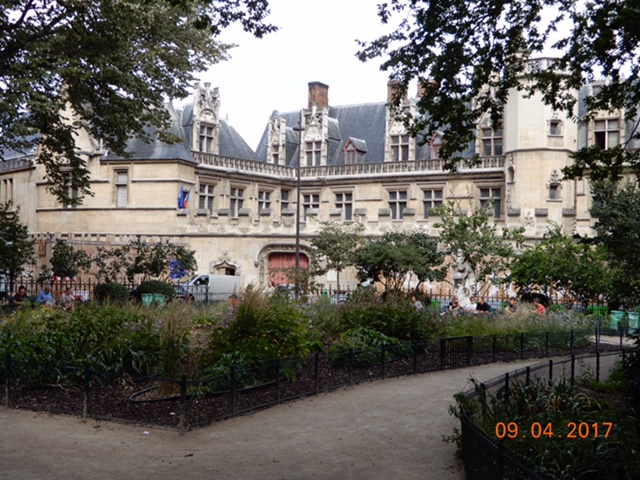
The Cluny Museum

The Cluny Museum is a former Paris home of a 16th Century Abbot of Cluny. It is undergoing a massive restoration project but was still open to visitors. Somehow, despite all our visits here, we managed to miss this museum.

The museum is the repository of medieval collections. My main interest in finally visiting this museum was to see the six tapestries entitled The Lady and the Unicorn. These are huge wall-hanging tapestries woven in the 1500s in what, at the time, were tapestry factories. They have as a focal point an aristocrat lady, a lion and a unicorn. The background is called the millefleurs style – a popular background filled with lots of varying flowers. I don’t know if the tapestries are famous because they have survived 500+ years or because they are so beautiful and their meaning so enigmatic, but I have known of their existence for decades. Five of the six tapestries are supposed to represent the five senses while the sixth’s meaning is speculative. Regardless of their meaning they are beautiful and I was so pleased to finally see them.

99F02C74-C723-4FF7-861C-732555E0EFB5

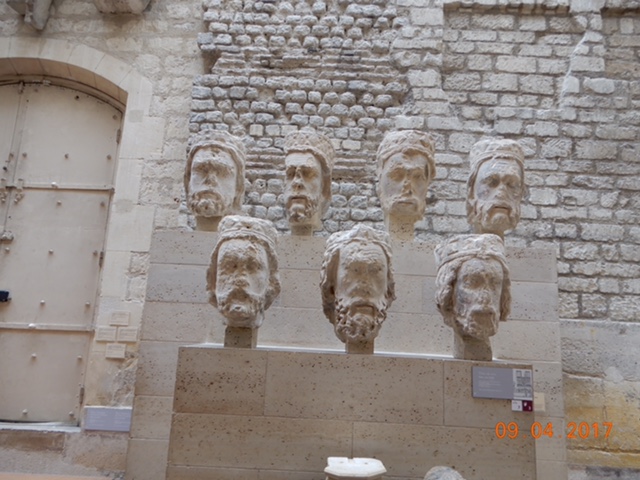
The Cluny also has the Gallery of Kings; 21 carved heads of the Kings of Judah, that once decorated Notre Dame but were pulled down during the revolution because they were thought to represent French kings. They were buried in rubble and only rediscovered in 1977. Other collections we saw included funerary sculptures, gold religious objects, choir stalls, and stained glass windows, but the Lady and the Unicorn won the prize.
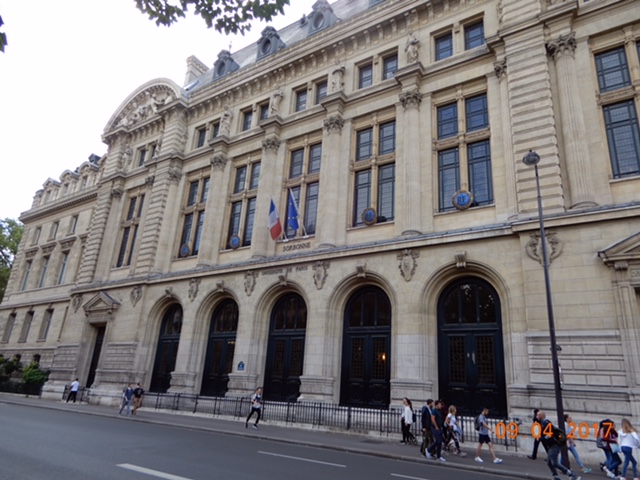
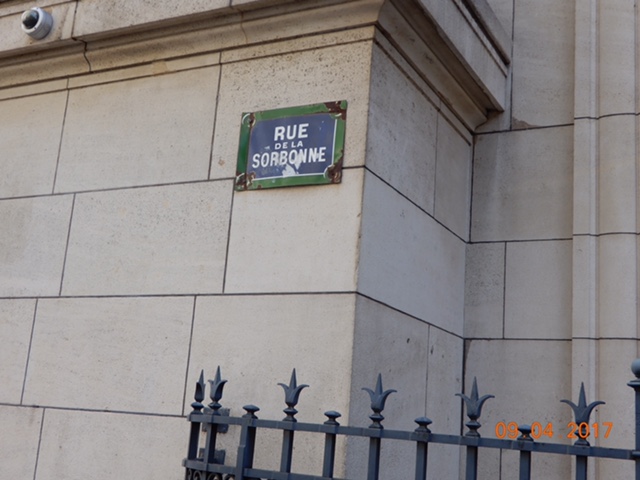
Two other sights we overlooked were the Sorbonne and the Pantheon. The Sorbonne is the historic house of the University of Paris. The university was founded in 1257 on the Left Bank and was historically famous for protests, right up to current times. We had walked the Left Bank innumerable times but never quite got to the university.

9C818DFA-DB6F-4B1A-8BAE-AD9E3A7DEE637936C3BE-76A4-415F-8DAA-9884963C535E

In our search for the Pantheon we walked right into the university district and finally saw the university building itself along with a lot of students.
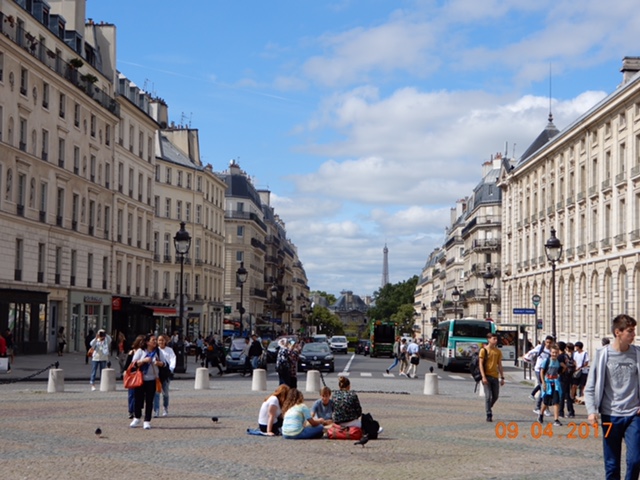
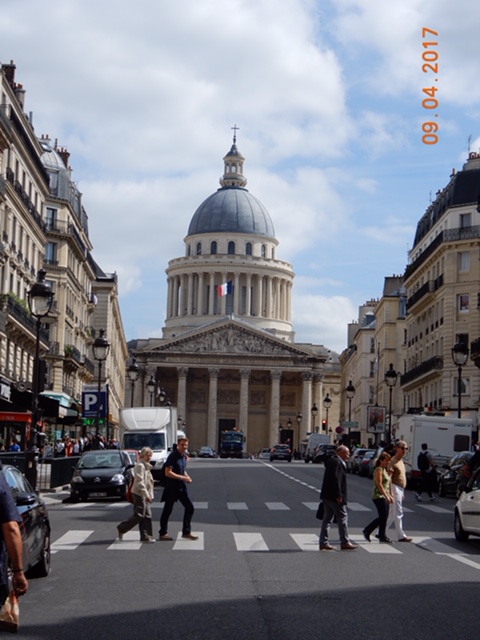
We continued walking the hilly neighbourhood when we entered an open space, obviously a square of some sort. Looking to our right we saw a handsome boulevard stretching down towards the Eiffel Tower. Looking to our left was… ta-da! the Pantheon.

A2B3D1E2-3ACD-4A2A-BDC9-834EDC4CF78C1C07E3B2-DE45-425B-BF55-D2CF60668406

The Pantheon was conceived in 1755(ish) by King Louis XV who, upon recovering from a serious illness, swore to build a church to honor St. Genevieve, the patron saint of Paris. It was to house her relics. After several delays it was completed in 1790 just in time for the French Revolution to decide that it should not be a church at all, but instead become a mausoleum for famous French intellectuals.
Among those buried there are Voltaire, Rousseau, Victor Hugo, Émile Zola, Jean Moulin, Louis Braille and its architect, Soufflot.

5A809FAA-1EBB-4716-97C5-BB232A2948CF

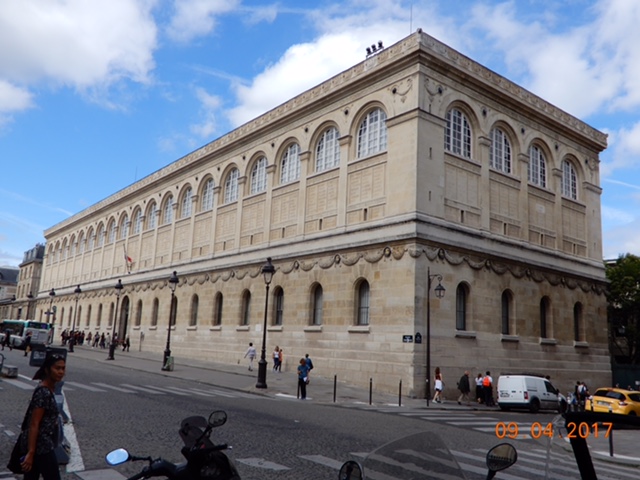
Just across a street from the Pantheon is the Bibliotheca St. Genevieve, a university library with 810 names of illustrious scholars inscribed on the exterior. The library contains over 2 million documents and its second story reading room is supposed to be an architectural marvel. I tried to get in to see it, but was denied entry. I guess you must have student or faculty identity cards to get in.

IMG_3797
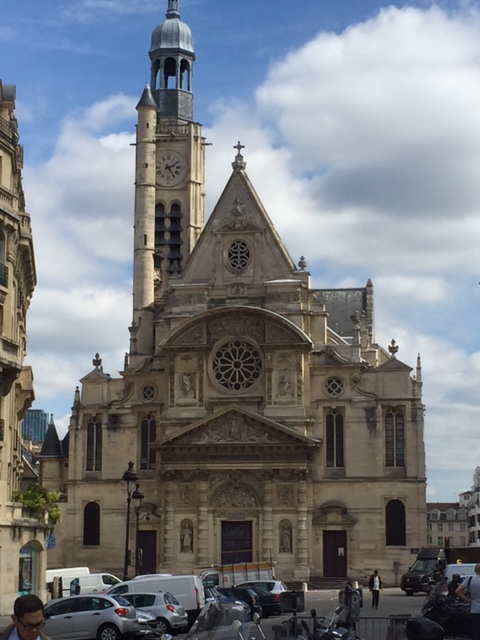
Behind the library and the Pantheon is St. Etienne du Mont. The church we see today was remodeled in various stages beginning in 1492 and being completed in 1640. It has had a pretty illustrious career and now holds St. Genevieve’s remains. According to what we hear the interior is well worth a visit but the church was lock up tight as a drum when we tried.

D85AE929-D23C-4324-BD62-630FC0A55E7E228D5456-914B-4461-B00A-C63D186A8C40

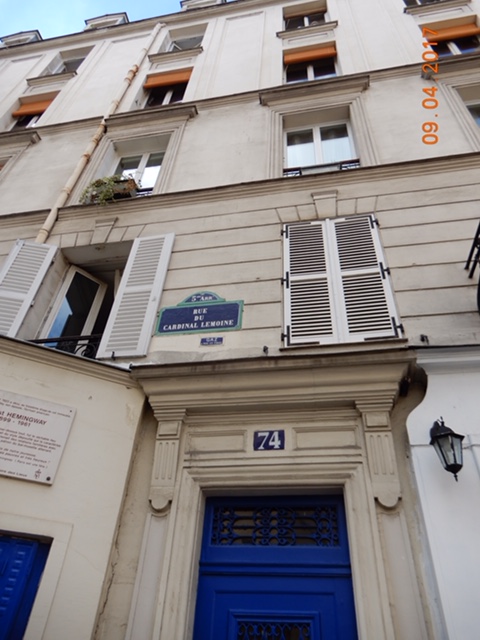
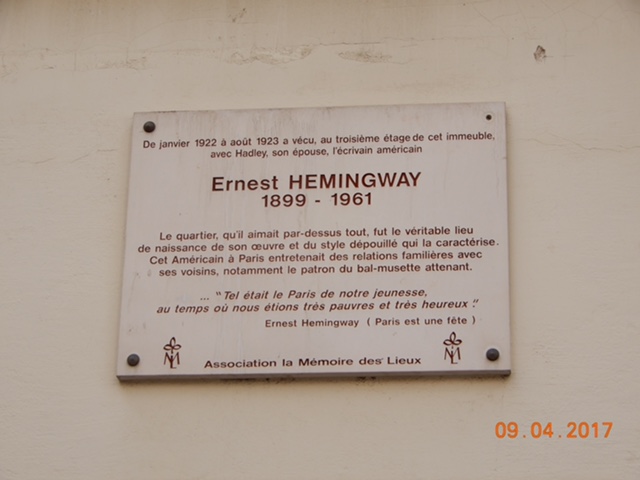
Not too far from these sites was the flat Ernest Hemingway lived in when he first came to Paris as a 22 year old. It is at 74 Rue Cardinal Lemoine and we determined to begin a Hemingway quest. By this time it was getting later in the day and we were both tired. We kept getting lost as we walked up and down a hilly maze looking for one very short street. Eventually we found it, but its lustre was dulled by our irritation with one another. We decided to continue the Hemingway quest another day when we weren’t so tired.

D1BFFA05-AC6C-460B-B60F-F8AC7FD3789E

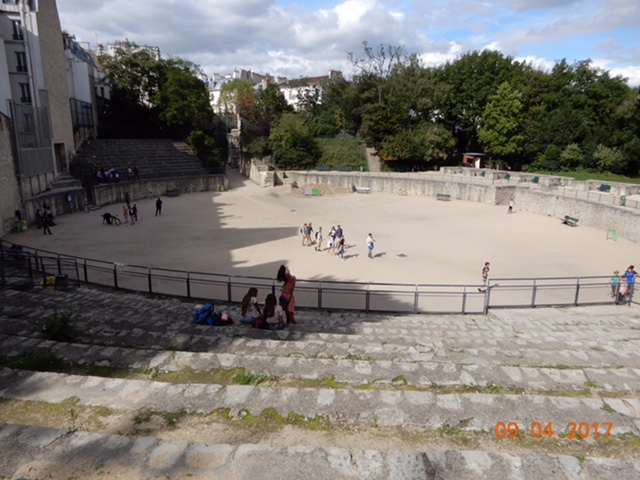
As we began our search for a metro station we saw that Paris had the remains of a Roman amphitheater not too far off our route. We made a quick detour to take a photo opp and watched people actually using the amphitheater. Old men were playing pétanque and youngsters were kicking a soccer ball around. Usually the amphitheaters we have seen are designated historical sites and are off limits to actual use. It was pretty cool to see this one being respectfully used.

Finally we made it to our metro stop and took it Port Maillot where we were supposed to pick up the campsite bus at 4:45. We arrived early and joined other campers waiting to return to the campsite. The bus was scheduled to come every 30 minutes on the quarter hour, but it didn’t come. And it didn’t come at 5:15. At 5:27 I called the camping (extremely surprised my phone actually worked for something besides data usage) and learned that today was the day they had changed bus schedules and the first bus would not arrive until 5:45. At least we only had 20 more minutes to wait, but some of our fellow campers had been waiting over 2 hours by the time the bus came to pick us up. We were really finished with the day by the time we reached our campsite.

The Cathedral City of Chartres

9/2/17 – Chartres:

After my lukewarm shower in Alençon, we continued our drive to Chartres. We asked Tami to take us the fastest route and, as usual, she took us where she wanted to go. As it turned out, her way was very scenic and since we weren’t in a big hurry, we didn’t complain.
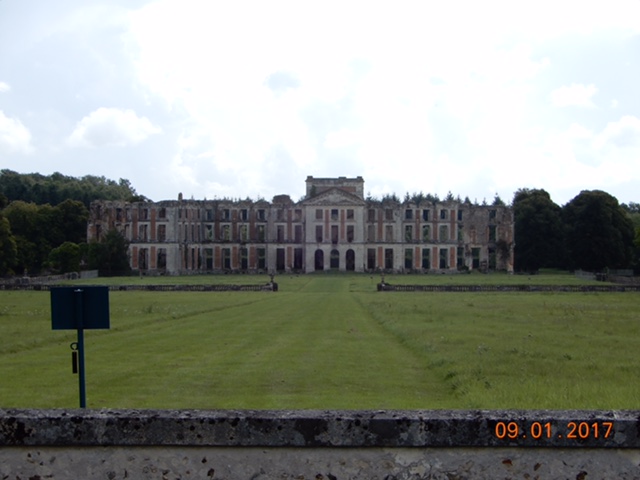
At one point along our route we found ourselves on an arrow-straight road pointing to a huge chateau. Approaching the chateau, we passed two large square ponds straddling the road and as we got closer still, we were able to see the chateau was completely in ruins.

DSCN3442

It was the Chateau de la Ferte-Vidame and it had quite a long history beginning in 1374 and ending during the French Revolution when it was plundered by looters. What we saw was the shell that, along with a vast amount of surrounding acreage, has been turned into a park and classified as a historic monument. We were fascinated by this ghostly structure with windows and roofline gone and through whose window openings plant life peeking in.

DSCN3448DSCN3450

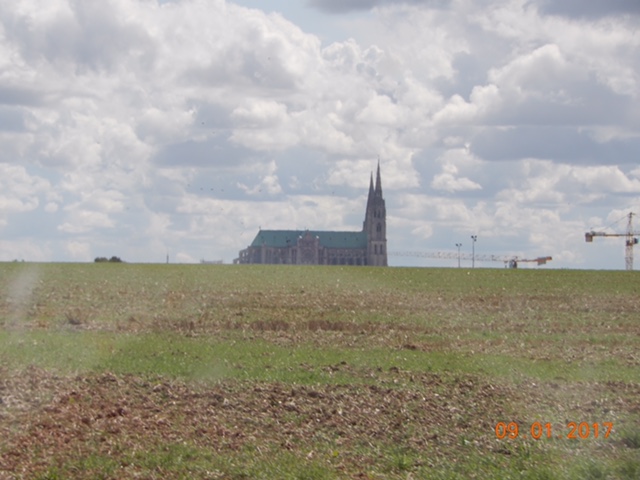
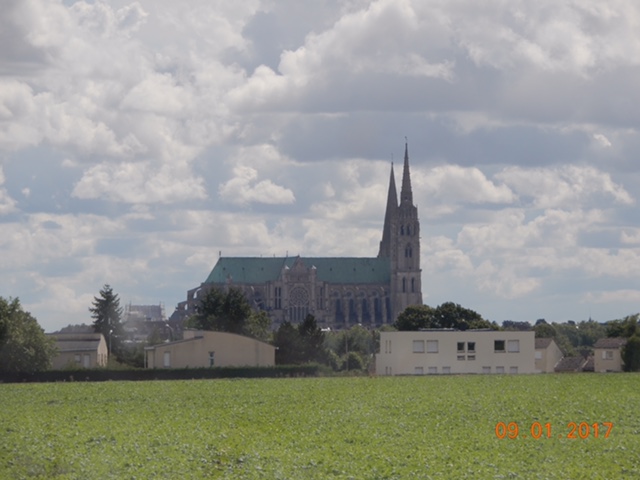
Chartres is only 32 miles from the chateau. After stopping for lunch, we began searching the horizon for our first sighting of the cathedral. The cathedral stands atop a hill and can be seen from quite a distance. When it is first spotted it appears to be a solitary structure. It isn’t until you are almost to the city itself that you can see the rest of the buildings that stand below the cathedral and make up the city. It is the most interesting phenomenon.

The land on which Chartres stands has a very long history. Before Christianity, a Roman temple stood, and before the Roman temple, it is believed to have been a Celtic Druidic center. Each religion attempted to erase its predecessor; so far, at about 1500 years, Christianity has held sway the longest.

IMG_3640BAD55FD4-9886-412C-9E11-D65466C540B0

D9A6DB6F-F96B-4975-B73F-88A9BBA5B97B
High alter

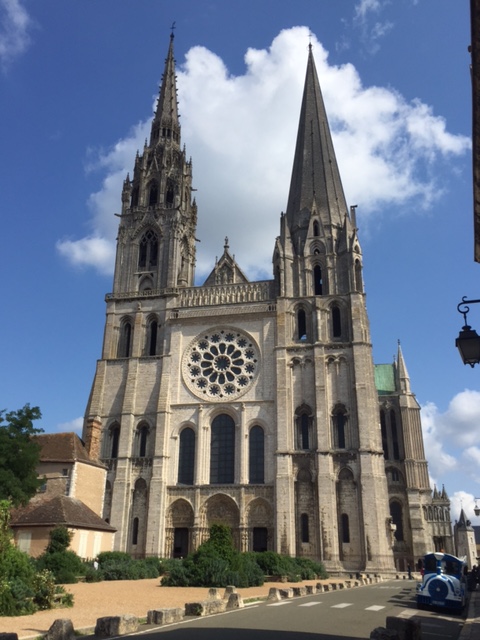
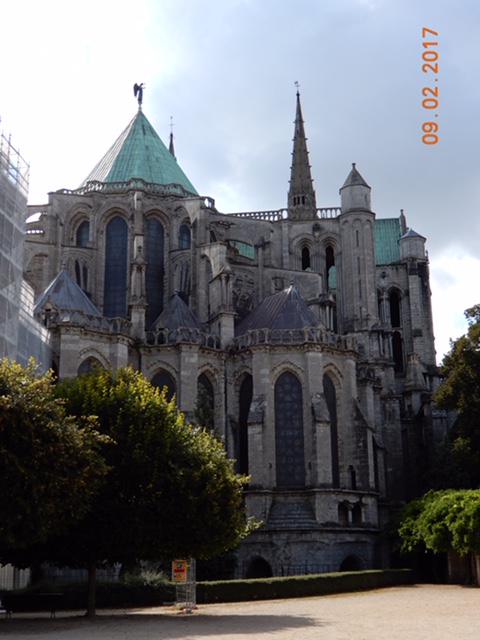
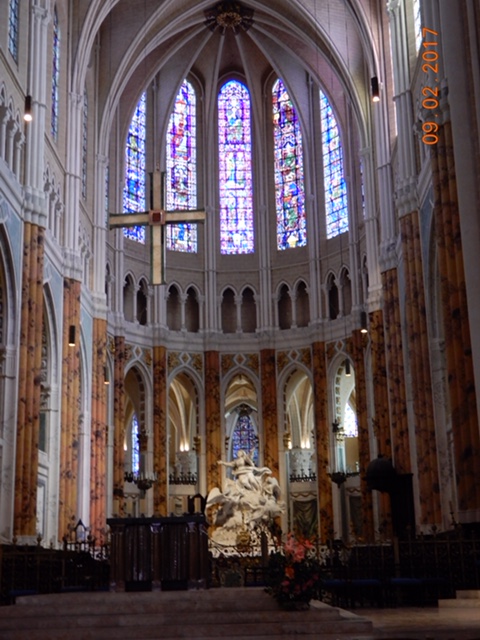
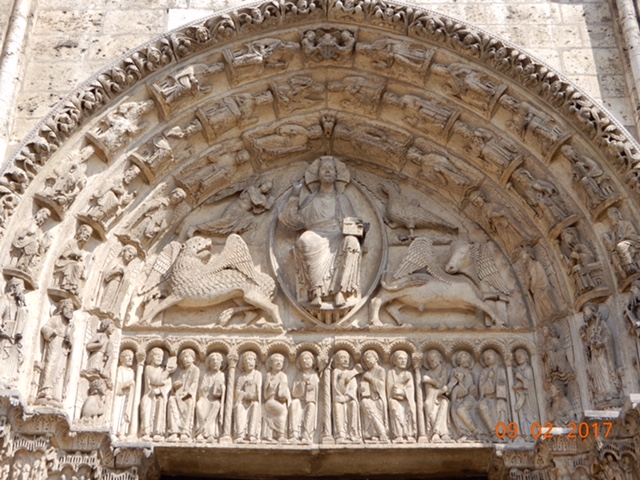
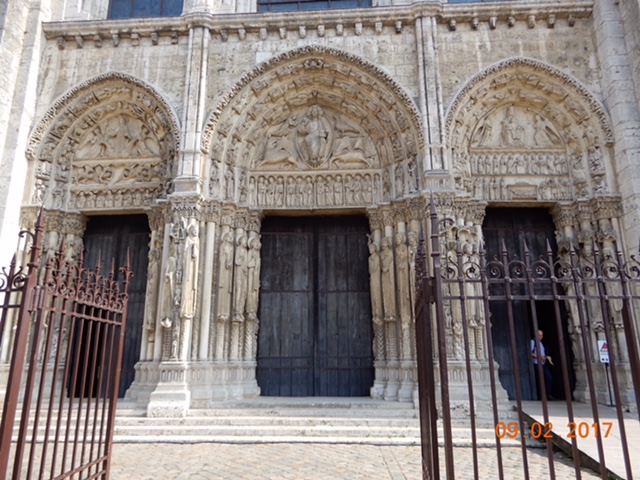
The cathedral is the last of at least five churches that have occupied the site since the 4th century. The medieval architects sought to make it “higher, wider and lighter than all previous churches.” It is probably best known for its beautiful 176 stained glass windows, but it also has an immense amount of sculptures depicting scenes and figures from the Old and New Testaments.

47BF0B6D-0C0F-4267-823E-8EE79039B225

54B63779-1623-4837-869B-09990936B56D

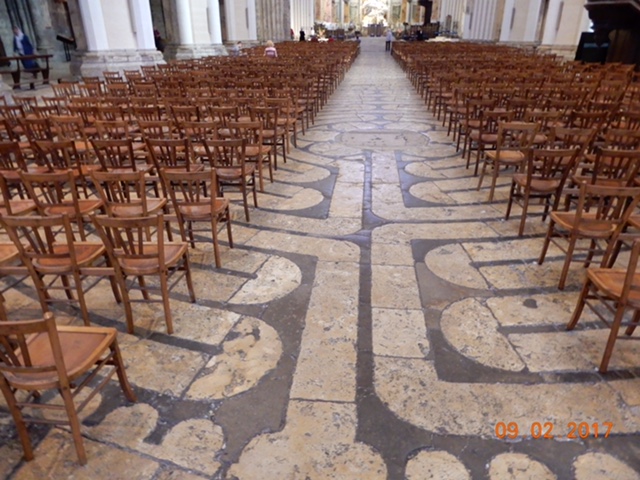
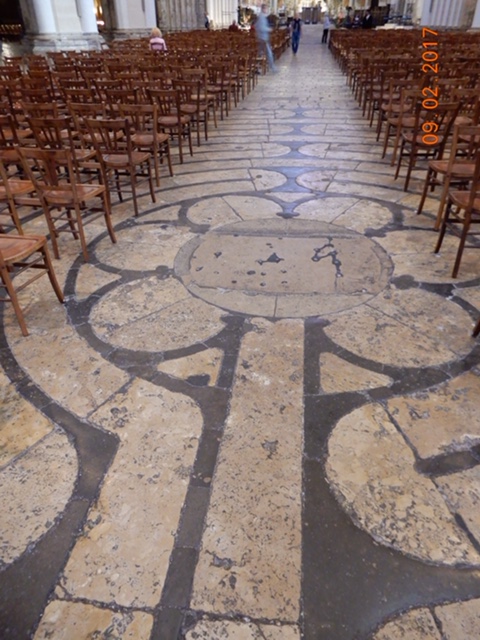
A large labyrinth was built into the floor of the nave and chairs are removed every Friday between Lent and All Saints’ Day so pilgrims can walk it.
The cathedral’s real name is the Cathedral Norte Dame Chartres (Our Lady of Chartres) and it venerates the Virgin Mary.

104C8D2C-DAEF-4A64-9599-CBBDEDB4C6D1
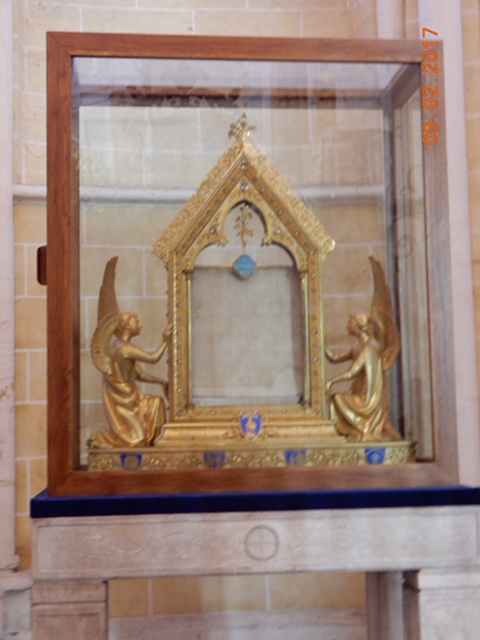
The holy tunic acquired in 876AD
DSCN3518
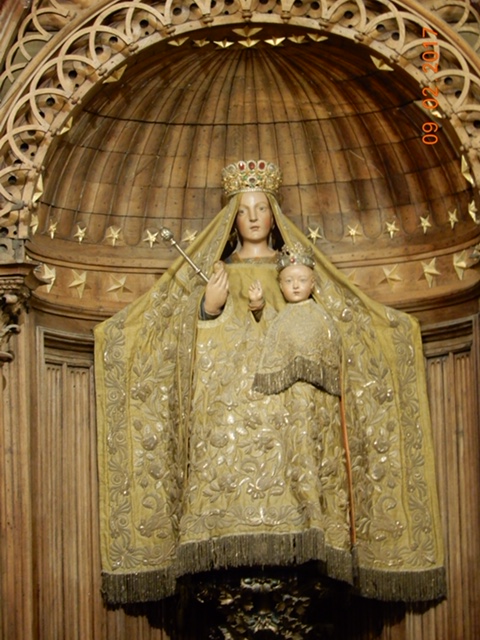
15th century Modonna and child

0A700F88-AA34-49A0-82C4-101E71FEEC31

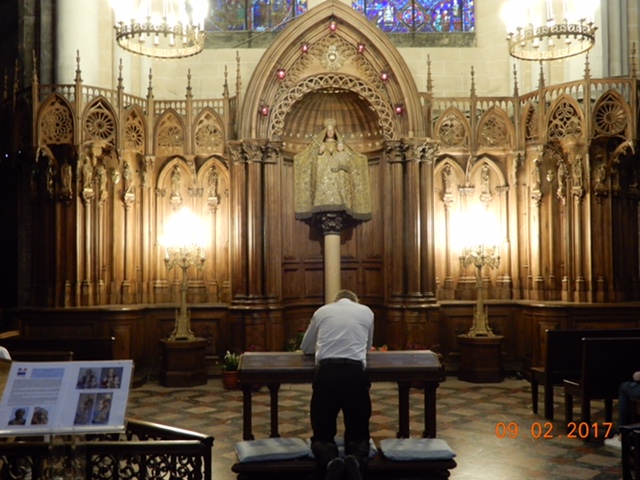
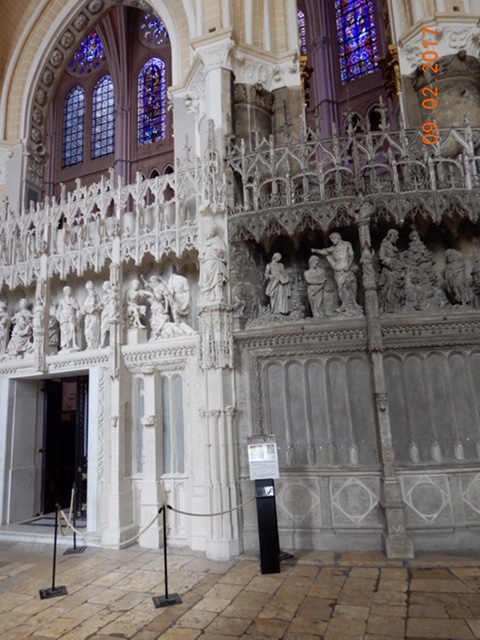
Around 876AD the cathedral acquired the “Sancta Camisa” believed to be the tunic worn by the Virgin Mary at time of Christ’s birth. By the 12th century the relic had made the cathedral an important place of pilgrimage. A great stone screen around the choir stalls displays scenes from the Virgin Mary’s life and continues through Jesus’ birth and death.

DSCN3512

A cleanup project that began in 2009 and intended to be completed by the end of 2017 shows the stark contrast between the smoke- blackened stonework and what was originally a bright and light interior.
There is a lot to see in this cathedral and we spent about 90 minutes just walking around the interior.

2641E563-E4EB-4496-A863-0AE2F8FB3C5FDSCN3472

Then we returned to the outside to examine the incredible statuary mounted all over the exterior. The cathedral is a masterpiece that was designated a World Heritage Site by UNESCO in 1979.

The old town spills downhill to rest on the banks of the Eure river. There are many half timbered buildings, some dating from medieval times. A covered market hosts a fresh vegetable market twice a week.

At the market square we were entertained by a Breton dance group, dressed in traditional garb and dancing to traditional bagpiped music. The Scots do not own a monopoly on bagpipes.

8/31/17 – Alençon, FR

We left San Malo on Monday 8/28 to begin a slow trek to Chartres and Paris. We got as far as Tinteniaç, a small village north of Rennes, in the eastern Bretagne region. The weather was hot and sunny and the amenities at the camping looked inviting. We decided to take advantage of the lovely weather and stay a couple of days. We planned to leave on Wednesday but the weather turned rainy and rather than drive in the rain all day, we opted to stay a third night.
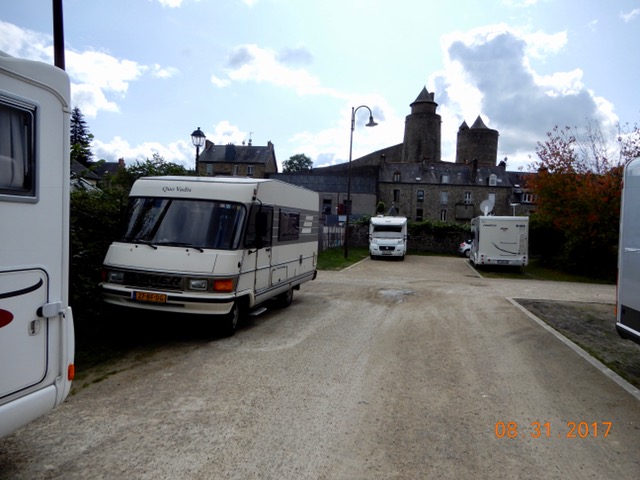
The clear skies returned on Thursday and we set off for a two-day drive to Chartres. While we were mapping out our route we saw the town of Fougeres had an 11th century chateau and we decided to stop and see it. It was a very pleasant surprise.

We found an aire and joined several other motorhomes parking right at the base of the chateau.

FullSizeRender
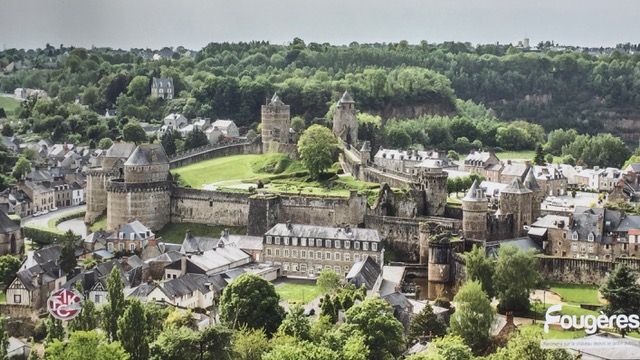
One thousand years ago, Fougeres was a promontory fortress sheltered by hills and surrounded by marshes. It was on the eastern border of the Duchy of Bretagne and perfectly situated to be a defender against the French. The current castle (chateau) dates from the 12th century. It is completely enclosed by ramparts and has 13 towers.


FullSizeRender

Although it is one of Europe’s largest medieval fortresses, we could easily walk around the exterior along the tourist promenade. It reminded us of both Angers and Carcassone, two other intact French fortresses with round towers and high stone ramparts.
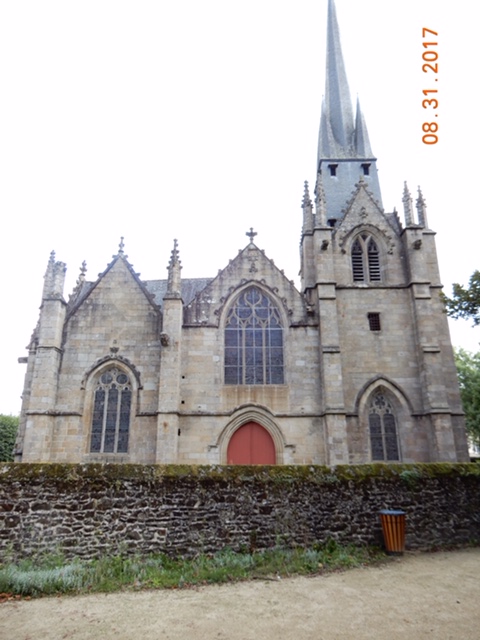
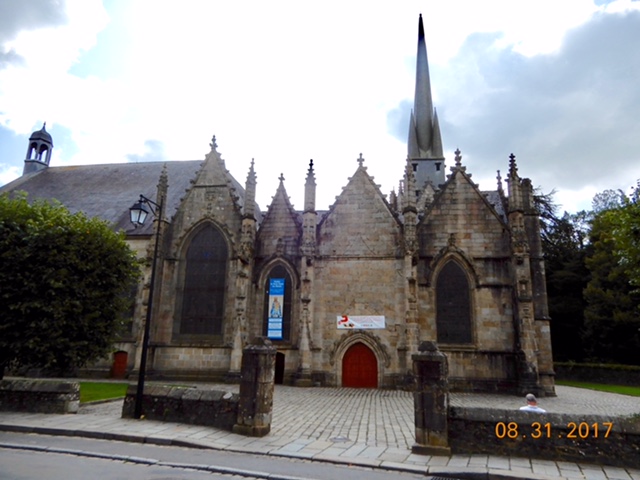
There was also a 1000 year old church, St. Sulpice, built in in the mid-11th century just to the south of the chateau. As the town grew so did the church, but the original building still stands. We have seen many churches and cathedrals in Europe that are 1000+ years old, or at least where a Christian place of worship has stood for 1000+ years, but rarer are the buildings that actually have survived 1000 years. St. Sulpice is one such church.

BFF00234-92C2-4EF6-AC45-19E60F29F00B0C8A9850-C92B-48E4-BFDC-02E990846453

I have said before and it bears repeating: I am not someone who follows any western religions, but I do love the places of worship the western religions raised to celebrate their God. The architecture, history and religious artifacts are impressive. We entered this 1000 year old church and immediately felt the weight of age.

Everywhere we looked we saw antiquity, from the nave whose painted wooden ceiling arched to resemble an overturned ship to the Lady Chapel alter with the statue of Our Lady of the Marshes, which, tradition claims, first lived in the the original chapel of the fortress.

The stained glass windows are probably the newest additions, dating from late 1800s to early1900s, with a few fragments surviving from the 15th Century incorporated in the crucifixion window. It is an impressive interior.
I do love old churches.

The town itself is typically laid out with small windy streets slipping between old buildings housing cafes, boulangeries, butcher shops, green grocers and individual homes. It is typically French and very quaint.
We saw a few tourists – and no one who spoke English – and there were no tourist buses, so it felt like we had discovered the place. The last time we “discovered” such a place was in Italy in 2008 at Portovenere, a little harbor town near the Cinque Terre. It has since been discovered, but back then there was room to explore the town. That is how Fougeres felt. I suspect some clever member of the local chamber of commerce with soon figure out how to successfully market Fougeres and in the process make the city a lot of money but ruin that which we found so special.

We spent the night in a municipal camping in Alençon, halfway between Tinteniaç and Chartres. It had the most primitive shower/toilet block we had yet encountered. We found our first “squatter” toilets of the trip and the showers had a shower head pointing directly down in the center of the tray with a pull chain to start the water. The hot water took about 20 pulls to even begin to warm up. It was a short and lukewarm shower. I had forgotten about the less than luxurious shower/toilet blocks offered in France and Spain campings and remember that I am now 69 years old and rather enjoy my simple luxuries. I wonder if I could use a squatter toilet at this age and be able to get up out of the squat! Fortunately they are not the only option…and we do have our cassette toilet in the camper.


8/26/17 – San Malo

After much consideration and taking into account the amount of time we have left for our trip, we have once again changed our itinerary. This cannot come as a surprise anymore, we have been continually changing it since we arrived in April. We will be going home in a little over a month so rather than spend long hours driving to Spain and Portugal and then turning around and driving long hours to return to Utrecht, we have decided to spend our last month in France and take our time to enjoy what France has to offer.

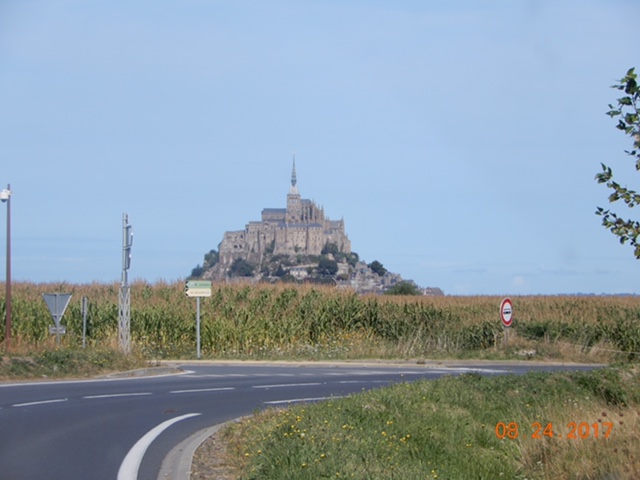
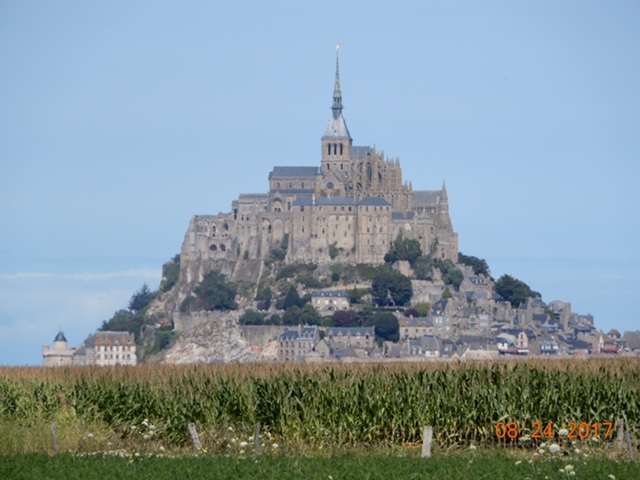
On Thursday, 8/24 we left the beaches of Operation Overlord and drove west towards Brittany to visit San Malo. Along the way we planned to stop at Mont St. Michel, the incredible monastery in a tidal basin that is daily cut off from the mainland by the tides. It was a place of religious pilgrimage for centuries. In modern times it is a tourist Mecca but still carries a wonderful aura of sanctity if you will take the time to wade through the layers of tourism. We have stayed twice at a conveniently located camping at the far side of the causeway to the Mont and thought it would be fun to have lunch there and take some new photos of one of our favourite places in France.
The approach to St Michel has changed in the 8 years since our last visit. No longer can we drive to the causeway and to the camping, but rather we, and all the cars, campers and tourist buses are herded towards pay and display parking lots were we then can board shuttles to the monastery. The parking is several kilometres from where we once could camp, and in fact we don’t even know if the camping is still there. The parking lots were almost full and the vehicles being funneled into the lots were backed up waiting to get in.
It was awful.

DSCN3194DSCN3199

We chose not to add to the madness. We got out of the traffic mess and stopped at a little frites stand where we made our lunch, bought some fries and took zoomed-in photos of one of our favourite places in France.

DSCN3214DSCN3207

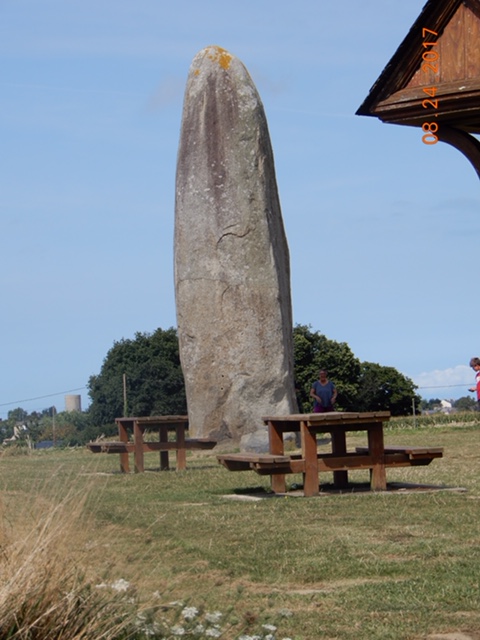
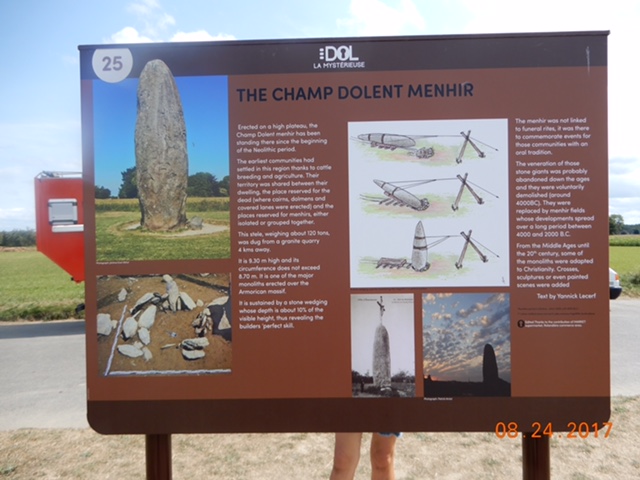
On our way from Mont St. Michel, looking at our map, I saw we were not far from a menhir (standing stone) we saw on our last visit to Britanny. It is called Le Champ Dolent and it is the tallest standing stone in Britanny, if not all of France. We detoured to see it again and it was as impressive on second viewing as it had been on the first.

A couple of years ago I read a book “All the Light We Cannot See” by Anthony Doerr. It is a novel of WWII. The walled port city of St. Malo, in eastern Britanny, has a starring role.
St. Malo, only 56 km from Mont St. Michel, had never been on our radar before, but the reading of this book definitely made it a must-see.

We found a camping very near the city on a small peninsula across the harbor: Municipal Camping de la Citi d’Alet. Alet was the original settlement of the area going back to Celtic and Roman times.

In the 18th century a fortress was built whose most recent occupants were the Germans in WWII. Our camping backs right up to the fortress.
During WWII the Germans took over the area, with that fortress behind our camping as a major defensive fortification. In August, 1944, with the Allied Forces advancing on Britanny, a major battle occurred as the Germans did everything they could to destroy the harbor of San Malo. The shelling between the Germans and the Americans bombarded San Malo and destroyed 70% of the city. The city was meticulously rebuilt in 12 years, from 1948 to 1960.
Somehow, on this trip we seem to be made aware of the incredible destruction WWII had on the cities and towns of Europe. Anyone who studied world history in high school or college is made aware of the destruction caused by war, but I think perhaps it is our visiting of these small compact cities, like Ypres and San Malo, and learning of the specific rebuilding projects they endured to come back to life, that makes it so immediate for us.

DSCN3346

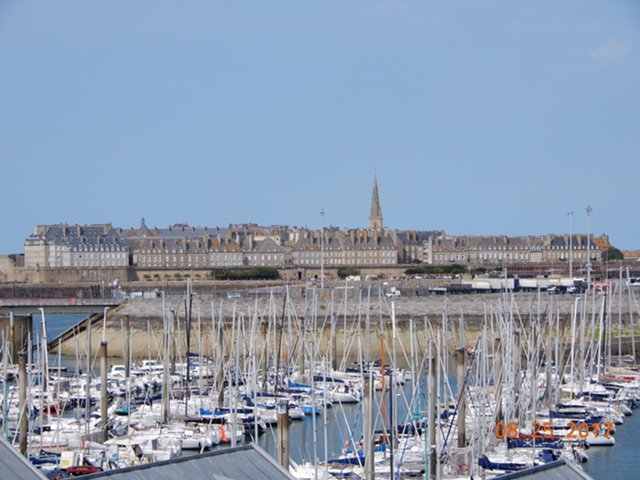
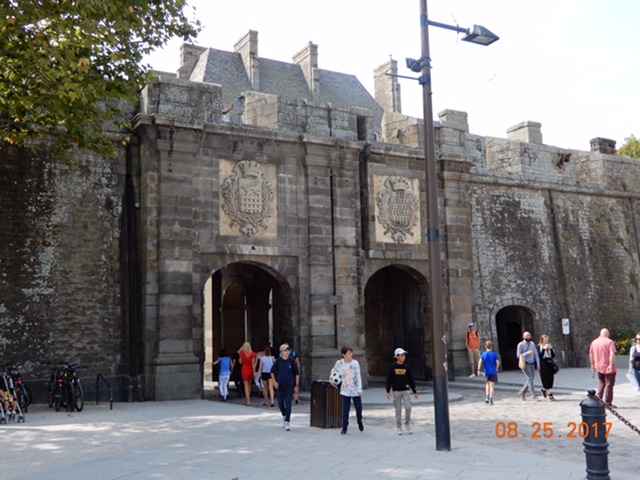
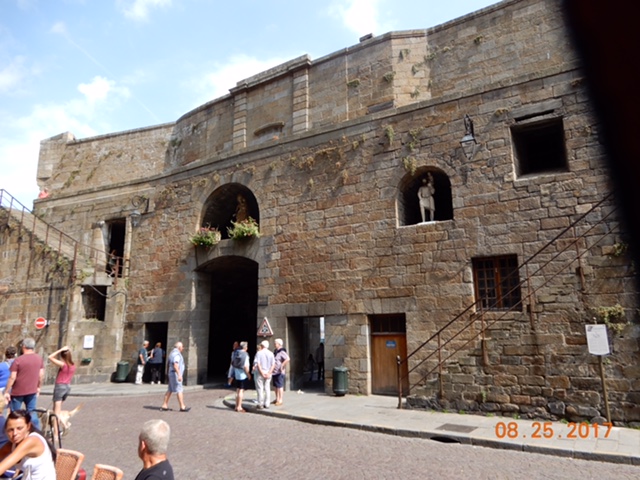
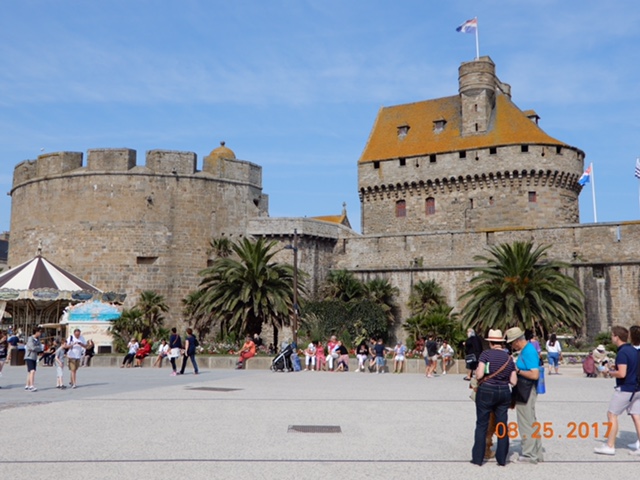
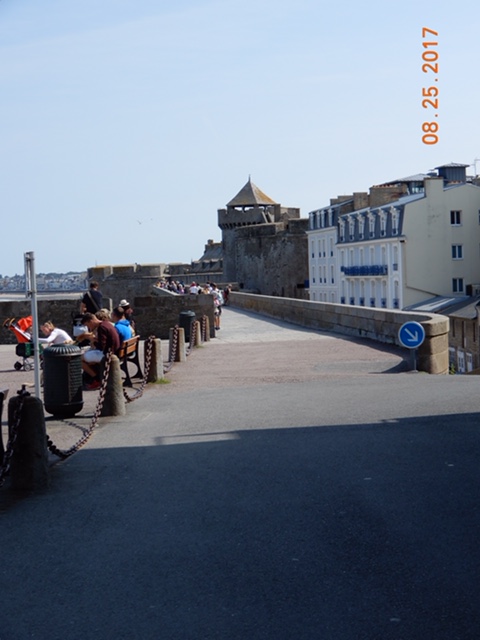
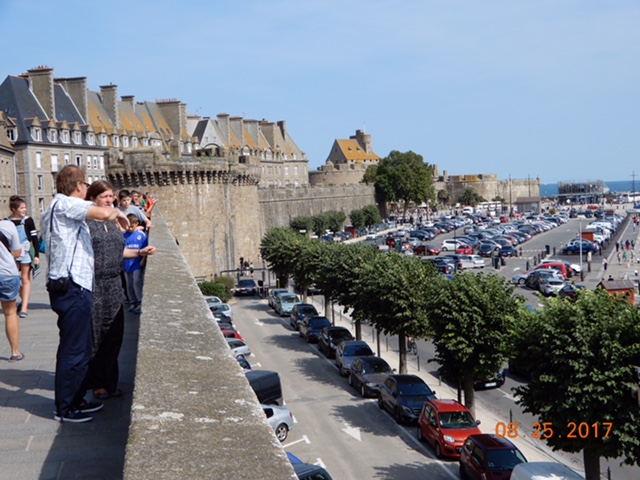
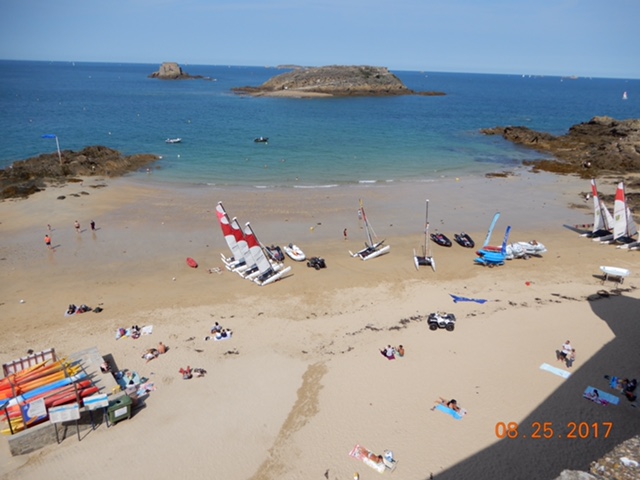
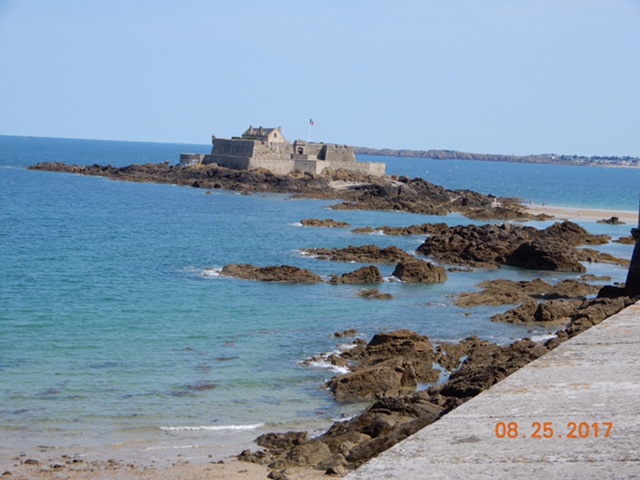
We took the 30 minute walk into San Malo on Friday, circumnavigating the busy harbor and entering the city through the Grand Gate. San Malo knocked our socks off. It is a compact walled city that occupies a small spit of land jutting out into the sea. It has mast-filled marinas on the land side of the city and sandy beaches on the English Channel side.

DSCN3261DSCN3262DSCN3341

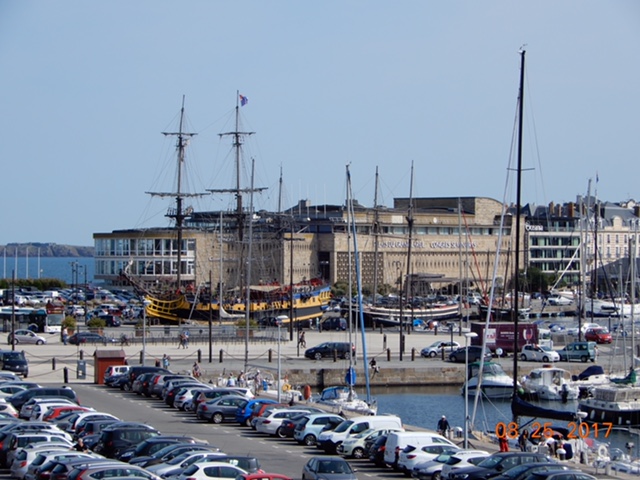
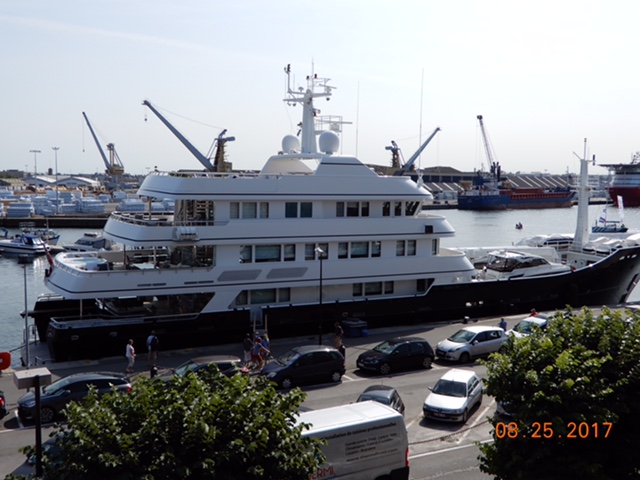
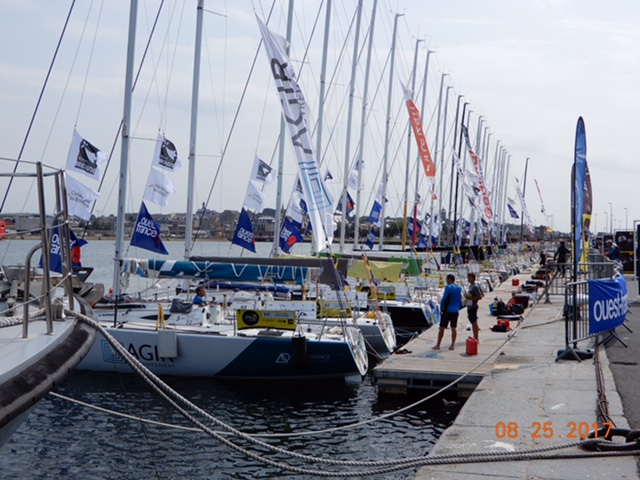
Approaching the city we walked the marina and saw a variety of ships. Among many, many others, we saw two replica corsairs, a four-storied yacht registered to the Cayman Islands and 24 Figaro-class, 2-man crew sailing ships preparing for a 6-day, 6-stage race around the coast of Britanny.


DSCN3337DSCN3333DSCN3252

DSCN3258DSCN3291

DSCN3263DSCN3271DSCN3283

DSCN3289


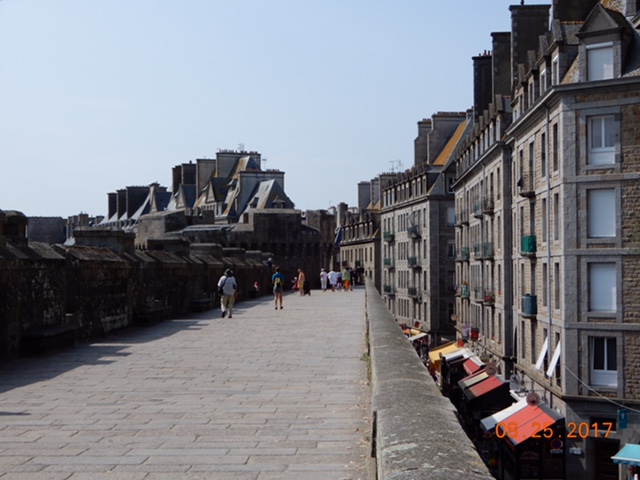
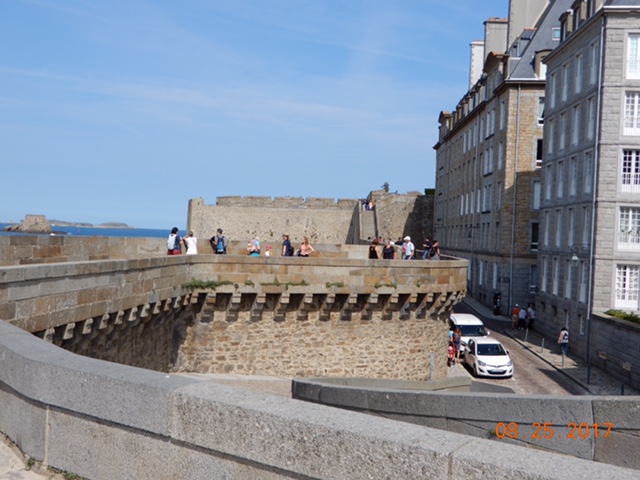
A walkway on the top of the ramparts takes you all the way around the city with gorgeous views on both sides of the wall. From a distance the city rooflines appear to be of uniform height and colour with Mansard-style roofs. A single tall church spire reaches up from the middle of town. Two fortified islands – Petit-Be and Grand Be – are accessible when the tides are low. A famous author from San Malo – Francois Rene de Chateaubriand – is buried on Grand Be. (I hate to admit it but the only Chateaubriand I am familiar with is the cut of beef.)


The town inside the walls has narrow cobbled streets, handsome stone-work exteriors on refurbished buildings and a restored cathedral with beautiful stained glass windows. The cathedral spire – one of the first casualties of the battle at San Malo – was not restored until 1971.

The cathedral has a unique bronze alter with the symbols of the four evangelists on each corner; a lion, an eagle, a man and a bull. The tomb of Jacques Cartier, the explorer who claimed Canada for France, is in a side chapel of the cathedral and a plaque commemorating the blessing of his first voyage in 1535 is in floor of the nave. There were lots of tourists and lots of shops and restaurants catering to them and yet it did not distract from the ambiance of the city.
We returned to our pitch very pleased we had decided to visit San Malo.

The Beaches of Normandy

Sunday, 8/20/17
We left Ypres Sunday morning with Jumieges, France as our goal. Seventeen years ago when we were in Rouen for a week, we had come across the ancient abbey of Jumieges and we had a hankering to see it again. The Abbey was consecrated in the presence of William the Conqueror and his wife Mathilda in 1067 and despite such an auspicious start, it had several ups and downs during its long history and was finally destroyed during the French Revolution. Today it is another of the romantic ruins that dot the European landscape.

We found a nice camping in the town of Jumieges and about 600 meters from the abbey. We did some laundry, had much desired showers and felt human again. Then we walked through the village of Jumieges to visit the abbey. Since it was early evening the abbey was closed, but an open air classical concert was playing on the grounds, and as we walked the walled boundary of the abbey taking pictures, we got to listen to the music.
We don’t often meet camping Americans, so when we do its kind of a big deal. Another couple, Bill and Sarah from Virginia, had rented a VW camper and were on a 3 month trip around Europe. We spent a couple of hours swapping stories and enjoyed hearing American accents. Interestingly enough, they were on their way to visit WWI battle sites while we were on our way to visit the WWII D-Day beaches.
The next morning we left Jumieges after deciding we had seen plenty of ruined abbeys and we didn’t want to take half a day touring that one.

8/21/17 – We Love The French!
Monday was a day of trials and tribulations.
We were following the meanders of the river Seine as she flowed to the sea at Honfleur/Le Havre when Bruce mentioned we were down to a quarter tank and needed to get gas (diesel). The first station we came across was an unattended one; no employees, just pay and pump. Past experiences with this type of station requires a debit card rather than a credit card. No problem, Bruce inserted his card and made ready to pump gas. Only the machine rejected his card. We tried my card and the machine rejected it too. We stood at the pump looking askance at it and thinking about panicking.
Our bank requires us to renew our overseas usage every three months. That meant a call to the bank (collect is accepted if you can find a landline that gets through to the international operator – but that is another story) so we could continue to use our bank debit cards. After a HUGE amount of difficulty I had managed to contact our bank while we were still in the UK to clear ourselves for another three months. Or so I thought.
The previous evening while walking Jumieges we had stopped at the bank and withdrew some cash from the ATM with no problem so we knew the card worked last night. Why wasn’t it working at the station? An occupied car was parked at the station and the driver saw that we were having troubles. He came over and using his card checked to make sure the machine was working: yes it was. Then we tried our debit card again and once again it was rejected. Bruce was getting pissed and I was freaking out. The man asked if we had any cash so we gave him €40 and, using his card, he pumped €40 worth of diesel for us. Yay! Merci beaucoup!! But why the hell weren’t our cards working?
Now that we had fuel we continued along until we could find a gas station with an attendant and try our cards there. Eventually we found one, added €20 more to the tank and learned our cards were working – it was evidently that one station’s peculiarity. My stress level began to decrease to manageable portions.
We drove on to Honfleur, a port town made famous by many Impressionist artists in the early 1900s. We were anxious to see the famous quays and houses. It has been a long time since we were in Europe and I cannot remember the masses of people flocking to the same places we want to see. I am serious about this, 2000 was a long time ago, true, but I can’t remember the crowding of streets like we have seen this trip. I know it is summer, but we have spent 2 summers in Europe and I don’t remember this.

Anyway, Honfleur was overloaded with people and the day was very overcast, muting the colors the Impressionists found so alluring. We found a slightly secluded spot at the harbor and had lunch before we braved the town center to continue our drive to Ouistreham, the eastern start of the Operation Overlord road tour.

We had just cleared Honfleur when we started hearing a faint sound like metal clanging against metal. We couldn’t for the life of us figure it out, but in very short order the sound was increasing and sounding horribly like two big pieces of metal ripping into each other. It was really quite scary. We thought it might have to do with the clutch because it seemed to be tied in with shifting gears, and yet the clutch had good pressure. Then we thought it might be the clutch cover plate pulled loose and hitting something. What we did know was that it was getting worse by the minute. As it happened we were in the industrial area of the town we were in and we saw a Citroen dealer with what looked like mechanic’s bays. We pulled in. It being France, we arrived during their two hour lunch break and had to wait for their return. When they did return they said they were not equipped to help us but directed us to a Hymer dealer in Pont l’Eveque, a short distance away. They gave us the address and we returned to Willie where we punched said address into the GPS and came up with results 250km away(!!!) There was no way we or the van were going to make that. Tami in hand, we went back to the salespersons and asked if that was right. They must have spent 15 minutes figuring out a way to get us to the Hymer place by inputting a nearby address that would get us there. All this for a couple of foreigners who were not going to benefit them in any way.
The actual destination, a Hymer dealership, was 15 km away and we crept to it. We saw a lot of beautiful Hymer motorhomes there but they weren’t interested in swapping. We asked about mechanics and once again, this was a dealership, not a full service dealership/garage, however, literally across the street was a mechanic. Thanking them we clanged our way across the street. We persuaded the office mechanic to come listen to our problem. The language barrier was pretty high but once he drove it around the parking lot and heard the sounds he thought it might be a fluid problem. We couldn’t imagine that. Another young mechanic came out and listened and the two had a conference about what, we had no idea, but the upshot was they took Willie into a bay and started pumping him with transmission fluid. They put in 2 litres (we have no idea what the capacity is but 2 litres is almost a half gallon) then took it out of the bay to drive and check it out. The sound was gone and the gearing and clutch worked beautifully.
They saved our asses.
We gave the young mechanic a €20 bill because he was awesome and walked into the office to see how much we owed. Another €20 bill and we were on our way.
There is a myth that the French are snobs and are unfriendly and hate everyone. We have had two car catastrophes in France, one was a blown engine 17 years ago, and today’s almost catastrophe where we could have lost a transmission. Both times the French have gone out of their way to help us. We can’t say enough good about them. They may at times find us to be unrefined or maybe a little silly, but when it comes down to it they are more than willing to help.
We stopped at a supermarket for some quick supplies. Returning to the motorhome we saw police surrounding the van. WTF??? As clearly as possible, given the language barrier – they spoke some English, we spoke very little French – they explained they believed an immigrant had climbed (or tried) behind our bikes for a little illegal hitchhiking. We had heard of this ruse before and thanked them for stopping it. Later though, after we had some time to think about it, we realized there is no way for anyone to hide under our bike cover behind the bikes because the space is filled with the “guest room,” spare chairs and wind guards. We think they saw the bulge behind the bikes and made assumptions. At any rate, we had to extra guests.

Continuing towards Ouistreham, searching out another Aires, we came across a camping on a canal and pulled in, emotionally exhausted.

8/22-23/17 Operation Overlord

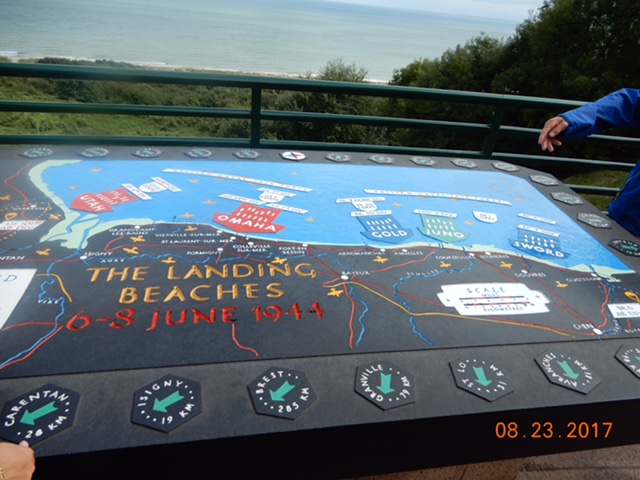
The Normandy Invasion of 1944 is still very much present along the coast where the five landings occurred. Sword, Gold, Juno, Omaha and Utah beaches were the designated names for the sectors along a 50 mile coastline. We have followed the Operation Overlord trail two different times on past visits to Europe and it still fascinates us.

DSCN3128

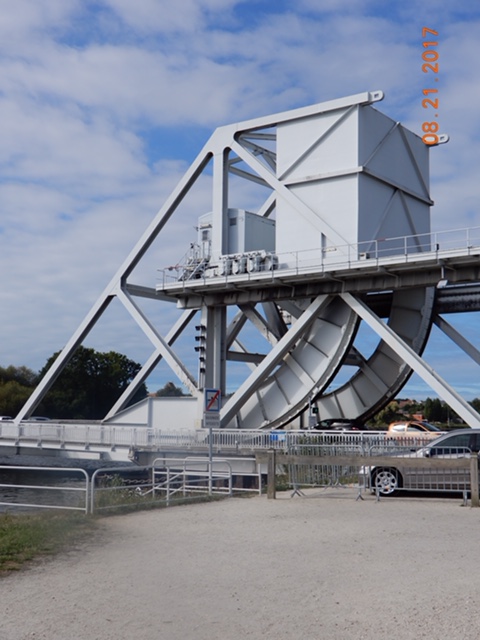
We started our invasion tour on the eastern front at Pegasus Bridge where, on the night of June 5-6, British gliders landed just outside Ouistreham on a narrow split of land between the Orne river and a canal, and captured the bridge within 10 minutes of landing.

As with all landings along the 50 mile stretch of coastline, this event is well documented at a museum and with signboards explaining the operation. The “landing strip” where the 3 gliders touched down is a very tight space; I don’t understand how they that landed on that strip of land without landing on top of each other.

DSCN3141

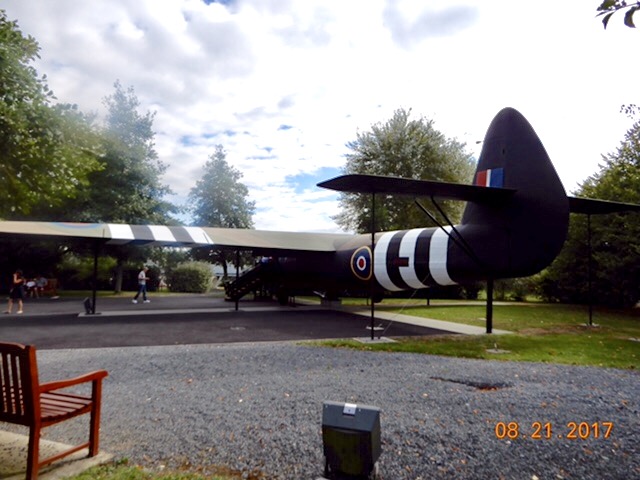
I’ll bet that when you think of gliders, you think of the sleek one or two man gliders we occasionally see in the sky or on film; elegant, quiet, long-winged aircraft flying gracefully through the skies. The British Horsa gliders used on D-Day were monsters capable of carrying 28 soldiers at once. Those were the soldiers who overwhelmed the Germans at Pegasus Bridge within 10 minutes of landing and in the process freed Ranville, the first liberated town of the battle.
Our next stop was Arromanches-les-Bains, part of the Gold Beach invasion. Once a foothold was achieved on D-Day a place to bring equipment to the continent was imperative. Arromanches became the location of an artificial port, Mulberry Harbor, a prefabricated port towed across the English Channel in sections and assembled at Arromanches. Mulberry Harbor was used for 10 months after D-Day and over 2.5 million men, 500,000 vehicles and 4 million tons of supplies landed there until it was decommissioned. You can still see remnants of the harbor in the bay.

We had been to the museum in the town itself, but up on a hill overlooking the harbor is Arromanches Cinema 360, a movie Theater with a very good 30 minute movie about the 100 days of the Normandy invasion. It uses British, American, French and German film to tell its story on 9 screens in a 360* theater. That hilltop also has remains of German bunkers overlooking the beach below.
That night we stopped at our second Aire just outside of Colleville-sur-mer where the American Military Cemetery is. We prepared for our visit to the cemetery by watching the movie, “Saving Private Ryan.” The opening and closing sequences of the movie were filmed at the cemetery. I said it when we first saw the movie in 1999 and I say it again: if women were in charge of the world we would never send our babies into the the killing fields of war.

F5889248-8205-47A7-B5B2-6A17ADFCF7338B2CC0C1-8F04-4EE9-AE32-CDA2196FC549EA99A7E8-C128-459C-8442-40FDD51E6922B36548CD-766E-4732-B014-E840A6CAB3BF030032E6-56B5-42C0-A05C-29F9A09276DA5F182293-DD36-43BB-B596-EE4613A80D142722FC4D-3512-4376-838A-10E61AA2B35D

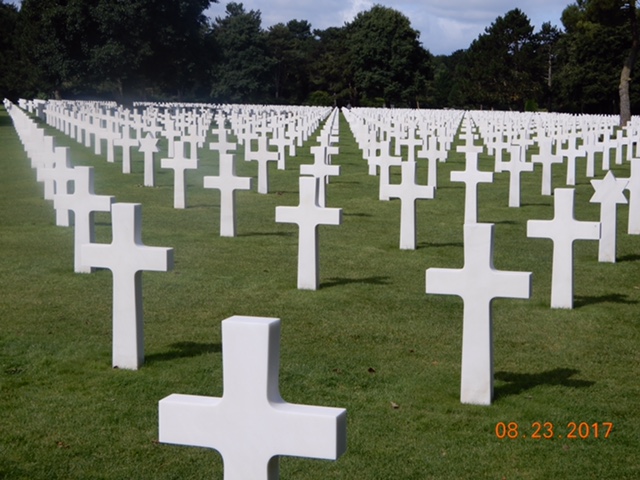
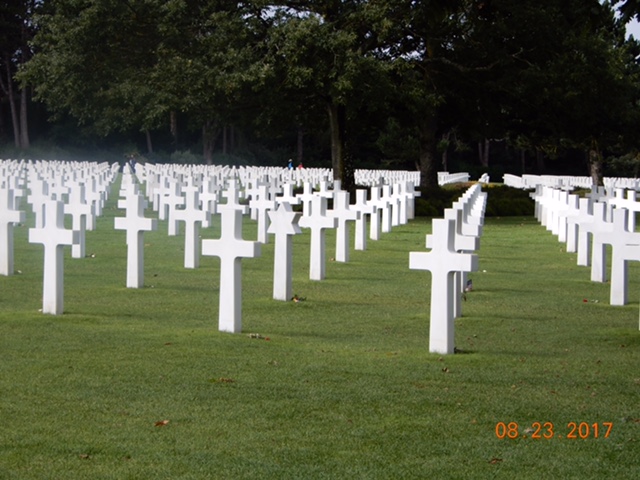
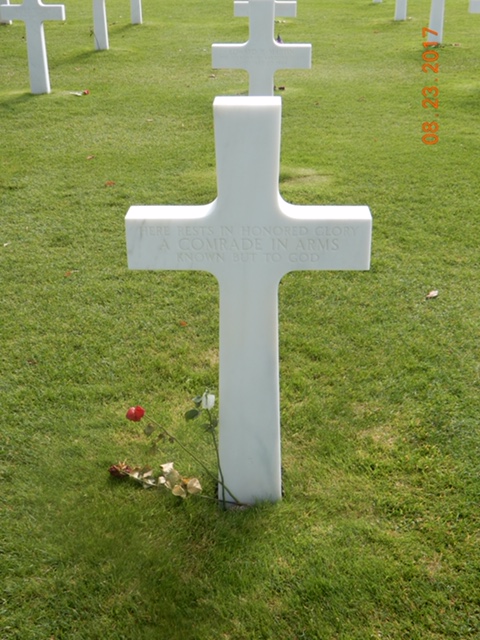
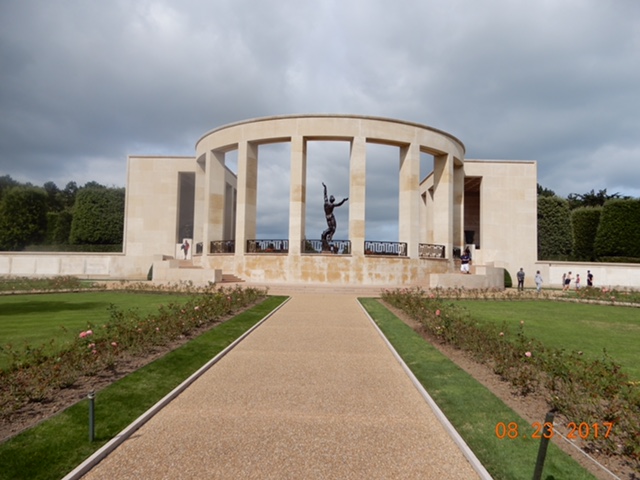
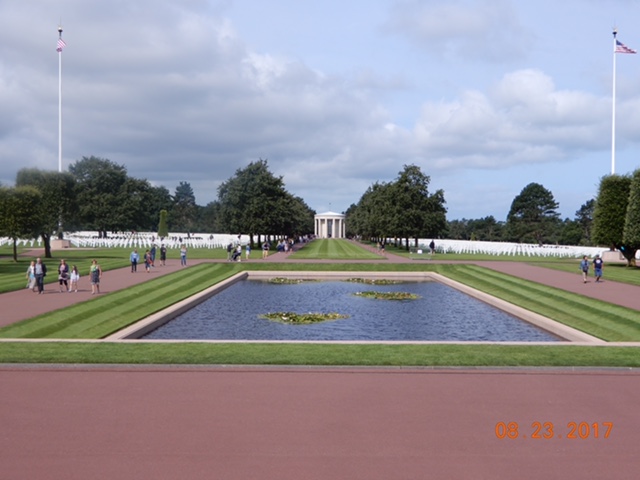
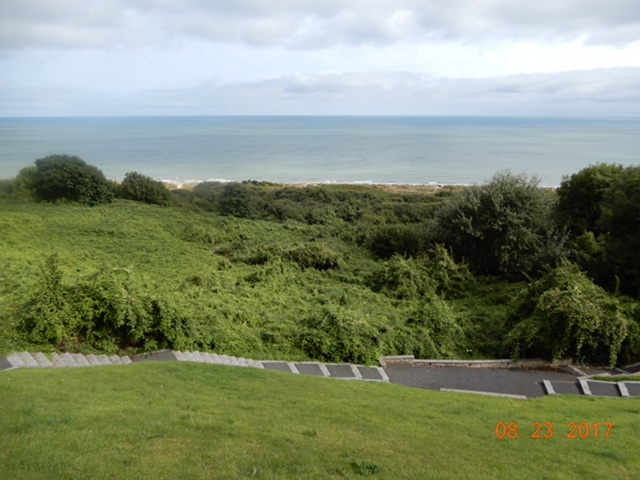
We have visited the American Cemetery twice previously and the 9,387 crosses make quite the statement about the costs of war. The cemetery covers 172 acres overlooking Omaha beach and grounds are serenely beautiful, as if to try and make up for the horror that overtook each soldier who died far from home and is buried there.

3E7A3646-826F-4D88-A852-D99A401CFAA1

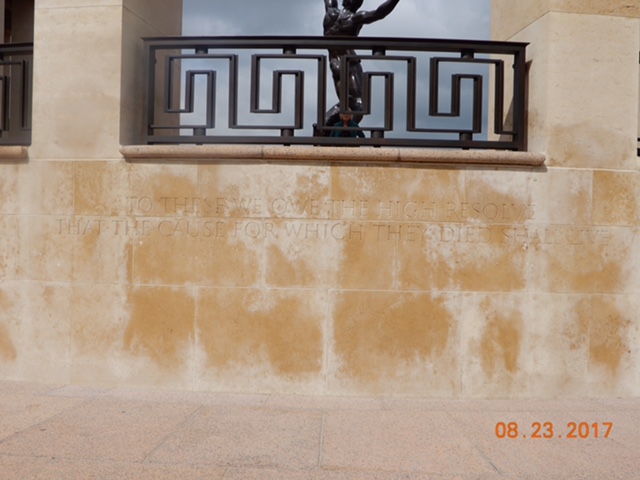
“To these we owe the highest resolve. That the cause for which they died shall live.”

These men died so that the nations of the world could live in liberty, free from tyranny. I think that quote is an appropriate epitaph.

Wiper


8/18/17 – Ieper/Ypres

We have experienced our first Aire of this trip. An Aire is a designated parking place for motorhomes. The Continent is full of them. While in England, we ordered books from Vicarious Books, listing all Aires for France and Spain.

IMG_3380

We are still in Belgium but we were told of this aire by a camping that was full and we could not get into.
Let me back up a bit:
In the morning we returned the plumbing parts we could not install, due to lack of proper tools, and began our return trek to reach the Normandy coast. Having seen a great deal of what the continent has to offer a traveling tourist, we were on the lookout for new-to-us places to see. Just NW of Lille, France is the Belgian town of Ypres, made famous for several battles in WWI and for the 500,000 men who lost their lives in one battle alone. The Fields of Flanders are the lands around Ypres.
Ypres is the French name for the town – the Flemish name is Ieper (that is a capital I -not a small L. I say that because our map made the name look like leper, which I chose to call it for a bit). The English speaking soldiers had trouble pronouncing the name and nicknamed the town Wiper. (It wasn’t until I read this little factoid that I realized my mistake.)
Ypres/Ieper/Wiper was along our path to France so we decided to give it a look. We found a camping that looked promising and plugged it into Tami. After a long day’s drive over smaller roads than we preferred, we arrived at the camping. It was in a perfect location for visiting the town. Unfortunately it was full with no openings until the following Wednesday – this was Friday. The camp host did direct us to the aire. This particular aire has 16 spaces for motorhomes at a cost of €8/24 hrs including electricity and a toilet dump. If you need water to fill your tanks, add €1/100 gals. It’s a great deal and still only 3km into town. What it doesn’t have is a shower but we could easily go 2 days at a time without one, then pop into a regular camping for the shower/laundry bit. I can’t say how often we will do this but its great to know it is as successful an option as it is.

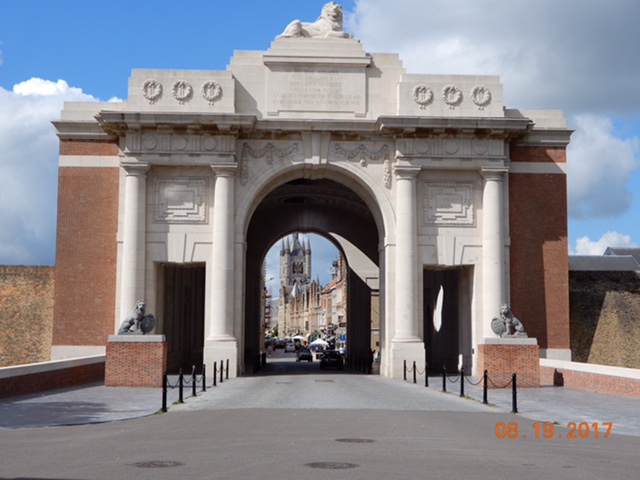
The city still commemorates the WWI fallen with a nightly tribute at the Menin Gate Memorial to the Missing. At 8:00 pm each night, traffic through the Gate is stopped while the “Last Post” is sounded by the local fire brigade. Imagine…a fire company that not only fights fires but also includes musicians in the force – how wonderful is that? The tribute is in honor of the memory of British Empire troops who fought and died there protecting the city. One hundred years later and the Belgians still honor the fallen soldiers of the British Commonwealth. I am impressed.

DSCN2883DSCN2884

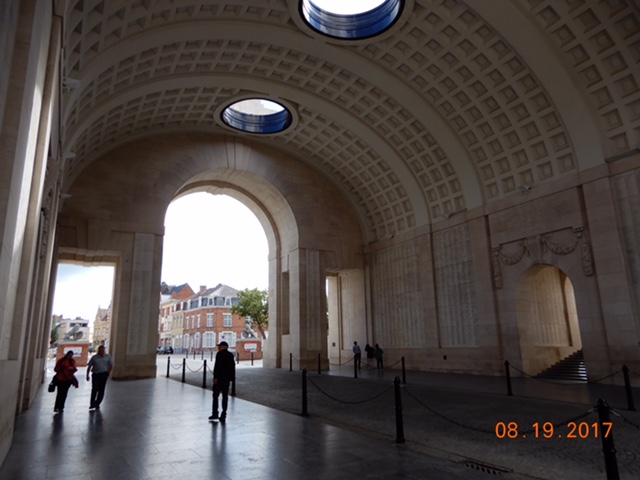
We went into town late Saturday morning since we intended to stay until after the Last Post ceremony. We rode our bikes the easy 3km into town and parked them near the massive Menin Gate, a historically important entry to the town center. This Menin Gate was constructed after WWI and dedicated in 1927. It records the names of 54,896 soldiers of the British Commonwealth who died at the Ypres Salient and whose bodies were not recovered.
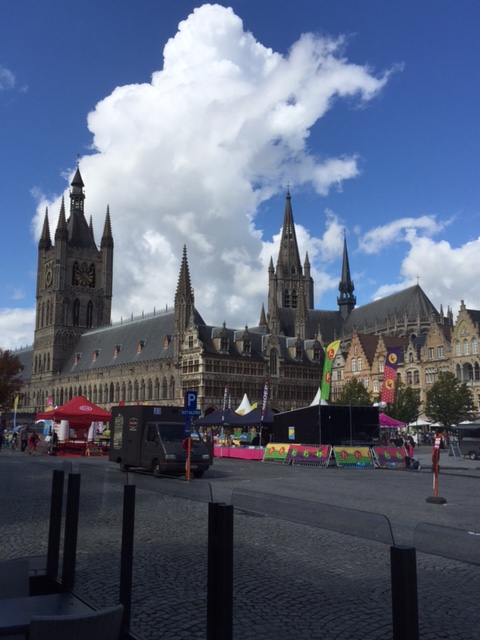
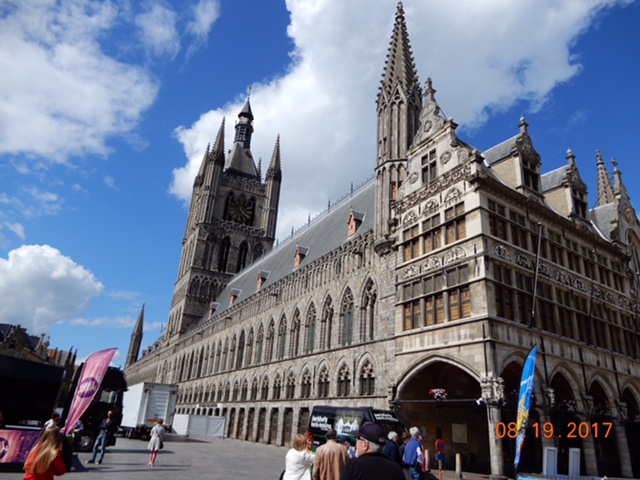
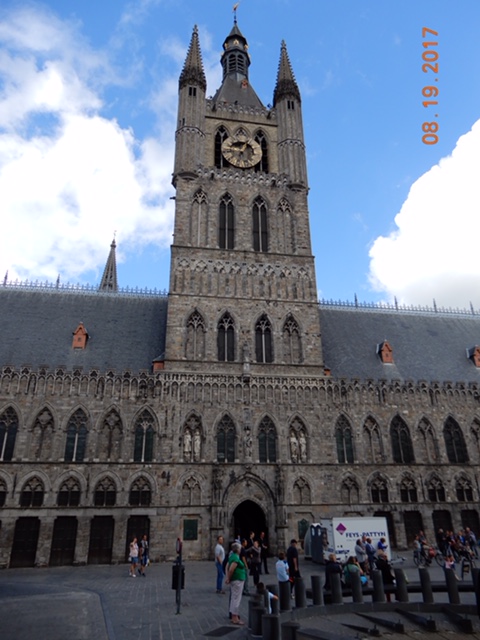
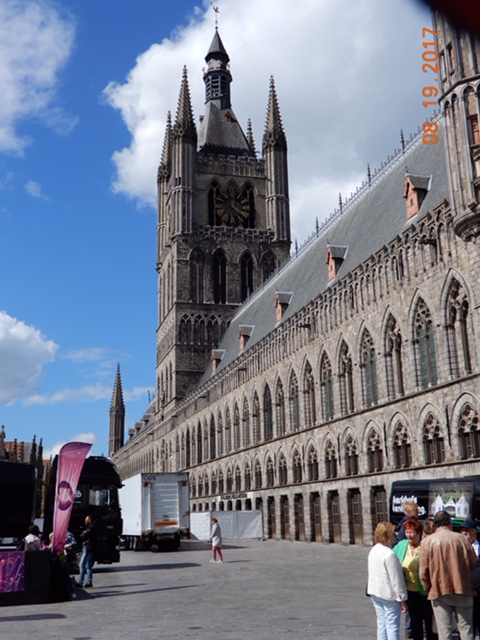
Ieper has a long long history starting with the Roman occupation in the first century BC. In the Middle Ages Ieper was a prosperous Flemish city and was mentioned in The Canterbury Tales. In the 13th century the Cloth Hall was built. It was one of the largest commercial building in the Middle Ages and served as a market and warehouse for the city’s linen industry.

In WWI the city and the surrounding area was pounded into the ground by artillery during the course of the battles that took place in the area.

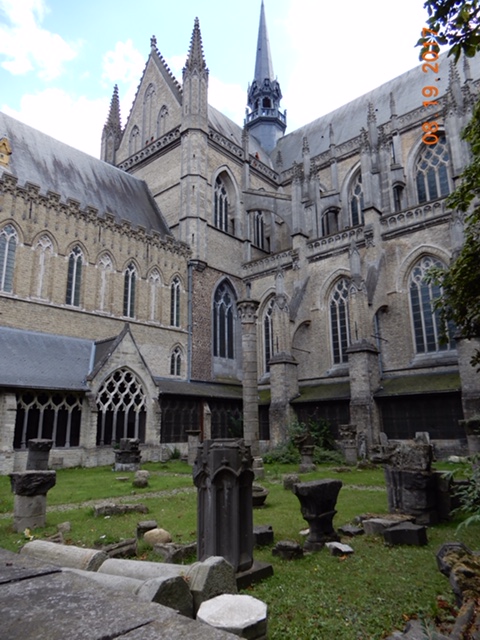
A massive rebuild was necessary when the war was over and much of it was accomplished by 1922 as attested to by dates on the buildings we saw. The Cloth Hall and St Martins Cathedral were built as exact copies of the original medieval buildings destroyed.

IMG_3312DSCN2896DSCN2910DSCN2897

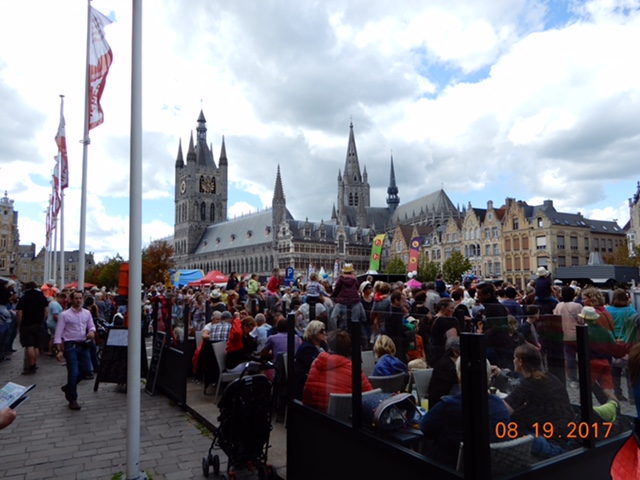
We walked through the Menin Gate, down the street and into the market square where we were confronted with the Cloth Hall – easily the largest and most impressive ancient secular building we have ever seen. To think the original building was built 800 years ago and didn’t belong to the Church was to realize the wealth of the city. The Cloth Hall contains the Flanders Fields Museum, that gives the history of WWI’s impact on Ieper and the immediate area. We had every intention of going through it but were so taken in by the rest of the city that by the time we returned to the museum, it was closed.

DSCN2926DSCN2950DSCN2951

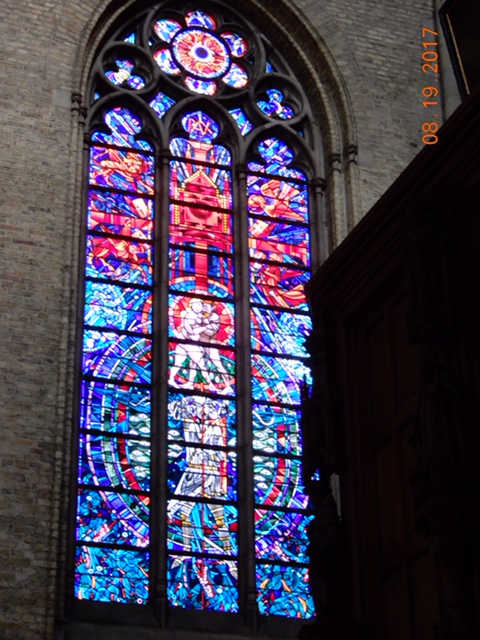
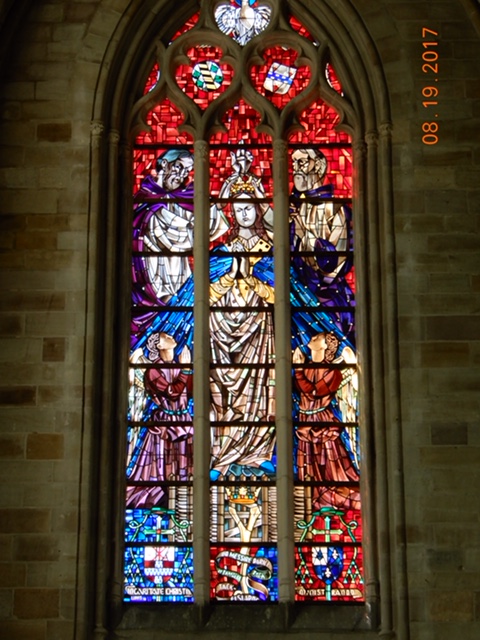
Right next door was the cathedral, also rebuilt after the war. The cathedral was an interesting study in stained glass window styles; ancient vs modern with a greater use of rich blues and subject matter that reminded us of the Chagall stained glass windows we have seen.

DSCN2979

That Saturday the market square was hosting a music extravaganza, the Ketnet Zomertour, a festival geared specifically to children 10 and under. Ketnet is evidently a TV show for young children and, if today’s event is any indication, it is wildly popular. A large music stage was set up and food and souvenir booths were spread all around the square. As the day progressed the square filled with families singing and dancing and enjoying the event. They kinda got in the way of our picture taking, but the enthusiasm was hard to resist.

We wandered around the inner city marveling at the complete remake of a city destroyed in the same century we were born in.

Then we walked the Ramparts, the fortifications that have protected the city for 1000 years. The latest incarnation was designed by Vauban, the French military genius, in 1680. Today the rampart walk follows the river across the Lille Gate, past one of the many WWI cemeteries in the area, along a lovely green belt and ending at the Menin Gate. We stopped for a bit to watch the “22nd International Kayak Water Polo Tournament” being played on 4 courses in the river amid founts of splashing water as kayak teams grappled for the ball and goals.

At 7:00 pm we positioned ourselves at the Menin Gate to make sure we had a good spot when the ceremony began at 8:00. At 7:30 barriers went up to halt traffic. Around 7:45 the Ieper fire brigade and a nearby youth marching band marched through the Gate to take position as honor guard. At 8:00 pm, three buglers made their entrance and played the Last Post – a bugle call often played at military funerals. It was followed by a moment of silence, the laying of memorial wreaths and then Reveille is played at the closing of the ceremony. This ceremony has been done nightly since 1928, with the exception of the four years during WWII when Germany occupied the country. Immediately upon the surrender of the Germans, the ceremony was begun again.
It is a respectful event and very, very impressive.

Back to the Continent

Wednesday, 8/16/17 – Ghent, Belgium:

Monday morning 8:00 am we boarded the DFDS Ferry line from Dover to Dunkirk. We arrived at 11:00 am Paris time, having gained an hour by crossing another longitudinal line from Greenwich prime meridian.

We were on our way to a camping store outside Eindhoven, NL but we were not interested in making a deadhead run there. We looked at our map of Belgium and decided to forgo Bruges, as lovely a town as you could want to see, because we have visited it twice on past trips. Ghent, is only a few kilometres further and we had not yet been there, so that is where we set our sights.

IMG_3291

After spending 2+months driving on the left hand side of the road, we were back to right hand roads and it was more of an adjustment than we expected. We were fine along straightaways, but roundabouts and left and right turns took a moments’ thought to make sure we ended up in the proper lane.
We chose one of the national highways for the 121km drive to Ghent. The national highways, while not as fast as the autobahns (European equivalent of American freeways), are a pretty efficient way to get from one point to another. They are also pretty boring; there is little picturesque to see on a track of land set aside for main highways. I prefer the roads that – on printed maps – are the next size down from the national highways, Bruce just doesn’t want to be driving in the bushes.
With little drama, we made it to Camping Blaarmeersen, located in a large sports park in Ghent.
We are both still suffering from our individual maladies: Bruce’s cold and my hyperextended knee so we got ourselves settled and rested the afternoon away. After a tasty dinner of baked turkey breast, baby courgettes (zucchini), new baby potatoes and a mixed green salad, we hopped on our bikes, for the first time in a couple of months (we were scared to death of bike riding on the little lanes of Britain). We rode along a lovely water sports canal that would take us into Ghent 3-5 km away. We were trying to decide whether or not to take the bus into town but the ride helped us decide to take the bikes.
Just before leaving on our bike ride, we learned we had no electrical power to our rig and neither did our neighbors. Previous to our arrival someone had driven into and knocked over a pole that looked like it had two air raid sirens on it that decidedly needed electricity. We were assured that an electrician was on his way out to fix it. When we returned from our bike ride we were told the electrician was unable to repair the power but they would surely have it up and running in the morning. We elected to stay in our pitch for the evening, we like our location. We needed to defrost our refrigerator anyway.
The next morning we awoke to a steady rain interspersed with thunder, lightening and heavy downpours. I began campaigning that we move to a new location. With all the rain and lightening I couldn’t imagine an electrician braving such elements to fix a shorted out electrical box.
We grabbed our rain gear and headed for the office where a young lady helped us pick a different pitch that to our delight was even better than the one we were leaving. We moved during a break in the rain and as soon as we settled in, the rain came in earnest and stayed all day. So much for visiting Ghent on Tuesday.
Wednesday the rain was gone and the sun was shining. It was time to go a-touring. We jumped on our bikes and rode to town.
We had read that Ghent was a well kept secret. With Bruges so near and so popular on the tourist trail, Ghent was often overlooked.


Ghent had its beginnings in 630 when a missionary bishop founded St. Bavo’s Abbey at the confluence of two rivers. In the Middle Ages the marshlands were no good for farming but were excellent for sheep raising and Ghent grew very rich with the wool trade, becoming for a while, second in size only to Paris. Holy Roman Emperor Charles V was born in Ghent in 1500. That distinction didn’t stop the citizens of the city from refusing to pay taxes to him. In retaliation he rescinded all rights and privileges and the city fell on hard times. The 1800s saw the city regain some of its power by becoming the first industrialized city in Europe.
Today Ghent is known as a university town with over 70,000 students who keep the town lively.
The historic city Center has many sights to see.

One is the Belfry, a UNESCO World Heritage Site. The belfries of Flanders and France were the symbols of freedom, power and urban prosperity. They were also the most secure places in the city. They often housed a city’s archives and vaults. Ghent’s Belfry symbolizes the city’s independence and contains the alarm bells which serves to protect its citizens. The Roeland Bell is the name of the alarm bells hanging in the belfry since the 14th century. The original large bell was taken down, melted and formed into a carillon of 40 bells. The largest of the 40 bells –renamed Roeland, cracked in 1914. It was taken down, repaired and now stands place of honor near St. Nicholas’ Church in the square.

IMG_3201

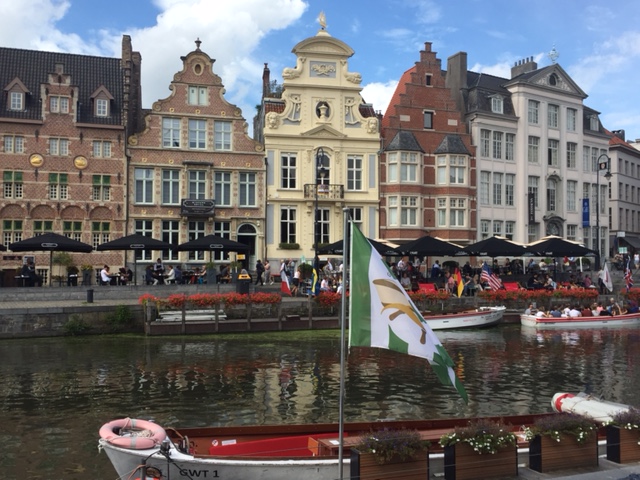
Flanking the river Leie are two quays, the Graslei and Kornlei. Once upon a time Ghent had a grain staple right: all grain that entered Flanders had to come through Ghent’s port. All boats that came into the port had to leave one fourth of their cargo as payment to use the riverways. The resulting wealth built beautiful buildings along the quays.

FullSizeRender
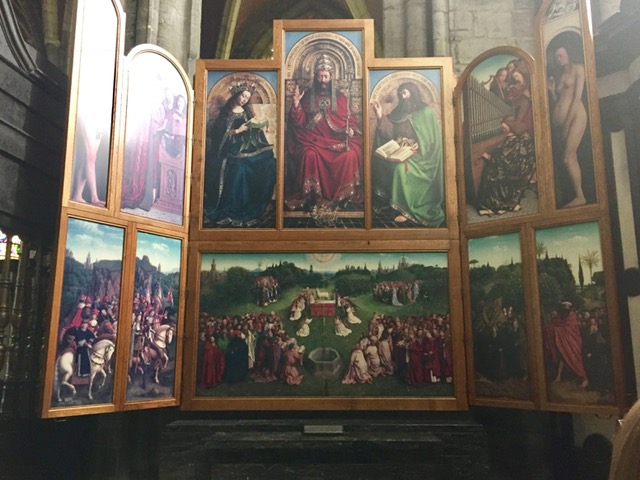
Ghent Altarpiece copy

St Bavo’s Cathedral is a couple of blocks away from the river and is in possession of the Ghent Altarpiece, painted by the Flemish brothers Van Eyck and unveiled in 1432. “The Adoration of the Mystic Lamb” is a 20-oak panel painting telling stories of the Bible. It is exquisite. I was able to take photos of a copy of the alterpiece but it does no justice to the original whose painted panels are bright and clear and almost glow.


IMG_3199
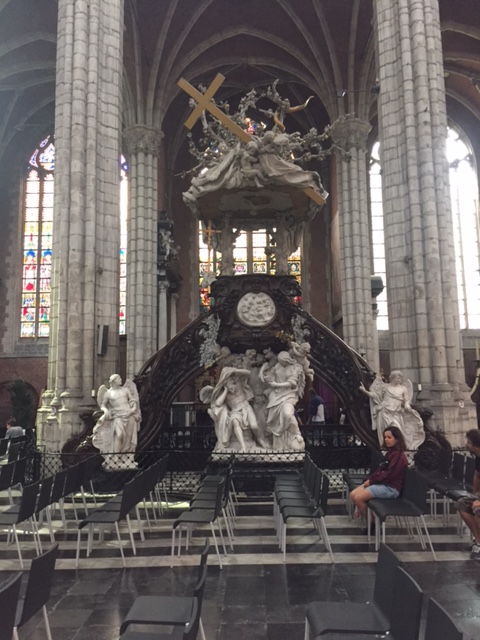
St. Bavo’s Rococo pulpit

St Bavo’s is a magnificent cathedral with many marble statues, oversized paintings of religious scenes and a Rococo style pulpit that is made of oak and gilded wood and white and black marble that is carved into larger than life size religious figures. It is the most over-the-top pulpit I can remember ever seeing. The cathedral is amazing and one of the more ornate ones we’ve seen in the Protestant north.

We had only spent four hours walking about the town but my knee was giving out on me so we decided to end our day earlier than planned. We missed a lot but at least we did get to see a new city.

We have come to a difficult decision. We are going to end this trip in October. We said when we came over that we would go home when it wasn’t fun anymore. We were able to see a lot of new ground in the U.K, but we have seen so much of continental Europe in our last two trips, that this trip was feeling repetitive. The Schengen dilemna has added to our frustration. And lastly, we are beginning to miss our house and friends. We couldn’t see extending the trip for another six months just to see Croatia. That means our itinerary is going to change – again. We are not going to Croatia, instead we will concentrate on western France, northern Spain and Portugal, new territory for us.